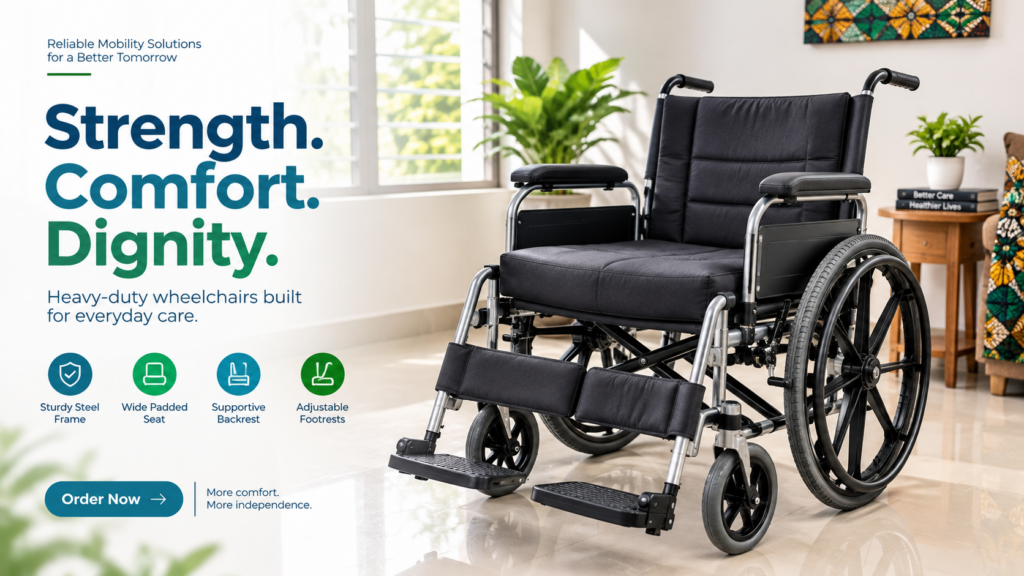
Imagine helping a loved one into a wheelchair, only to realise that the seat feels too narrow, the frame does not provide enough support, or the chair simply was not designed for the person’s size. That can be frustrating for the user and stressful for the caregiver. For families searching for heavy-duty wheelchairs in Nigeria, the challenge is not simply finding a chair that looks strong. It is finding one with the right weight capacity, seat width, frame construction, wheels, brakes and overall dimensions for the person who will use it. And that is where many buyers make a costly mistake.
A wheelchair can look wide and sturdy in a photograph but still have a lower weight capacity than expected. On the other hand, a wheelchair with a high weight rating may be too wide for the user’s doorway or too heavy for a caregiver to transport.
So, what should you actually look for? In this guide, we will break down heavy-duty and bariatric wheelchairs in simple terms, compare them with standard models, discuss current Nigerian price examples, explain the specifications that matter most and show you how to approach your purchase with confidence.
What Is a Heavy-Duty or Bariatric Wheelchair?
A heavy-duty wheelchair is designed for users who require a higher weight capacity and, depending on the model, a more robust frame or wider seating configuration than a standard wheelchair. A bariatric wheelchair is commonly designed around the needs of users who require greater weight capacity, additional seating space or both.
However, there is an important distinction to remember: A wider wheelchair is not automatically a heavy-duty wheelchair. Likewise, a wheelchair described as “heavy-duty” should not be assumed to have the same weight capacity as another heavy-duty model. Always check the manufacturer’s specifications.
Important details include:
- Maximum user weight
- Seat width
- Seat depth
- Frame construction
- Wheel and caster specifications
- Brake system
- Overall chair width
- Chair weight
- Folding dimensions
- Footrest configuration
The World Health Organization recommends an individual process of assessment, fitting, training and follow-up when providing wheelchairs. It also notes that no single wheelchair model or size can meet the needs of every user. That means the goal is not to find the biggest wheelchair you can afford. The goal is to find the appropriate wheelchair for the person.
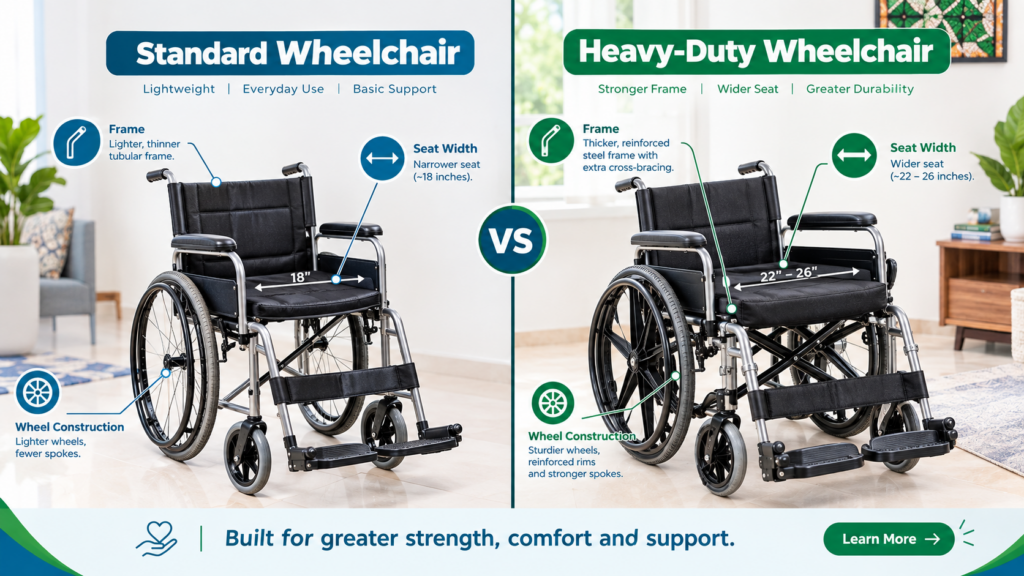
Heavy-Duty vs Standard Wheelchair: What’s the Difference?
At first glance, the difference may seem simple: one is stronger and the other is lighter.
In reality, there is more to it.
| Feature | Standard Wheelchair | Heavy-Duty/Bariatric Wheelchair |
|---|---|---|
| Weight capacity | Standard range | Higher stated capacity on appropriate models |
| Seat width | Usually standard sizes | Often available in wider configurations |
| Frame | Standard construction | May use reinforced/heavier construction |
| Wheels | Standard configuration | May use heavier-duty wheels/casters |
| Overall weight | Often easier to handle | Can be heavier |
| Portability | Generally easier | May require more planning |
| Price | Usually lower | Often higher |
| Intended use | General mobility | Users requiring greater capacity/support |
For example, HemacNG’s current standard wheelchair listing has a stated maximum user weight of 130 kg and is listed at ₦145,000.
That does not mean every user close to or above that figure should simply select a heavy-duty wheelchair without assessment. Weight is only one part of the decision.
Seat dimensions, posture, mobility, transfers, environment and intended use also matter.
How Much is Heavy-Duty Wheelchairs in Nigeria?
This is probably the first question many buyers ask.
Unfortunately, there is no single nationwide price for heavy-duty wheelchairs in Nigeria.
Prices can change according to:
- Weight capacity
- Seat width
- Frame material
- Brand
- Wheel construction
- Reclining functionality
- Commode functionality
- Importation costs
- Exchange rates
- Availability
- Supplier
- Delivery
Current Nigerian online listings illustrate just how wide the price range can be.
For example, Waltson Global currently lists a Heavy Duty Steel Wheelchair at ₦170,000 and an Extra Wide Steel Wheelchair at ₦160,000.
EquipMedMall currently lists a Bariatric Sentra Extra-Heavy-Duty Wheelchair at ₦550,000, with a 22-inch seat option shown on the listing.
Another Nigerian supplier currently gives an indicative range of approximately ₦150,000–₦400,000 for reclining or bariatric/heavy-duty wheelchairs, while noting that prices can move with exchange rates and shipping costs.
So, if you are budgeting for heavy-duty wheelchairs in Nigeria, think in terms of a range rather than one fixed price.
Current Nigerian examples
| Product description | Current listed/indicative price | Important consideration |
|---|---|---|
| Heavy-duty steel wheelchair | ₦170,000 | Check actual weight capacity |
| Extra-wide steel wheelchair | ₦160,000 | Width does not automatically equal higher capacity |
| Bariatric extra-heavy-duty wheelchair | ₦550,000 | Listed with 22-inch seat option |
| Reclining/bariatric/heavy-duty range | ₦150,000–₦400,000 indicative | Price varies with specifications |
These figures are examples of current listings, not a guaranteed market-wide price list. Always confirm the current price, stock and specifications with the supplier before paying.
What Weight Can a Heavy-Duty Wheelchairs in Nigeria Carry?
This is one of the most important questions to answer before buying. Unfortunately, there is no universal answer. Heavy-duty wheelchairs in Nigeria could have a very different maximum user weight from another model carrying the same description. Therefore, don’t buy based on statements such as: “This chair is very strong.”
Strength is not a specification. Look for an actual manufacturer-stated maximum user weight or weight capacity. And remember that the user’s weight is not the only measurement that matters. You should also consider:
- Hip width
- Seat width
- Seat depth
- Sitting posture
- Leg position
- Transfer ability
- Overall wheelchair width
A chair that technically supports a person’s weight but does not provide an appropriate fit is not necessarily the right choice. WHO’s wheelchair guidance places individual assessment and selection at the beginning of the wheelchair provision process.
7 Features to Check Before Buying a Heavy-Duty Wheelchair
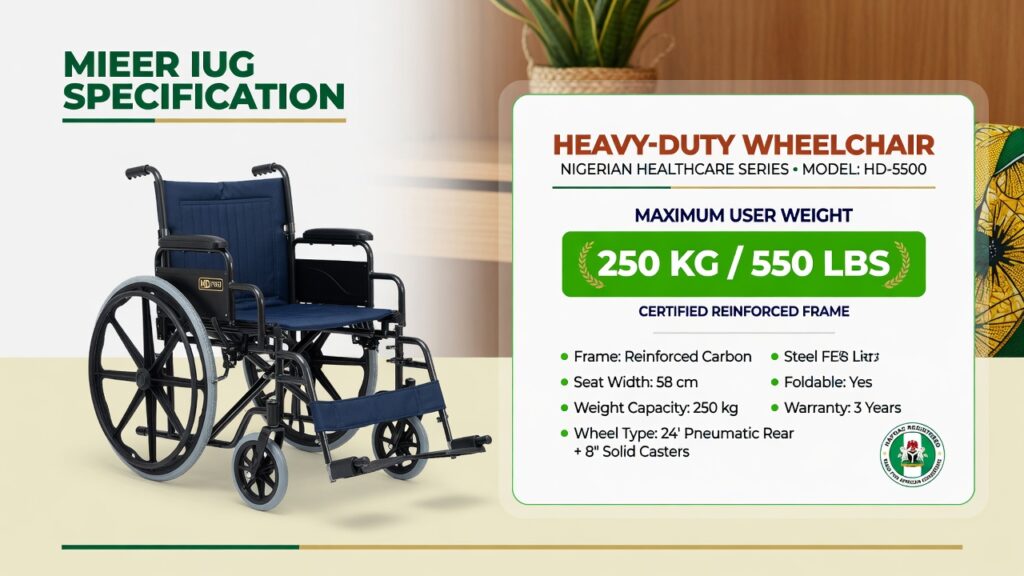
1. Weight Capacity
Before looking at colour, upholstery or extra features, check the manufacturer’s stated maximum user weight. For example, if a product is rated for 160 kg, that specification tells you much more than simply describing it as “heavy-duty.”
Do not guess the capacity. And do not assume that two products with the same seat width have the same load rating.
2. Seat Width
For many buyers, seat width is just as important as weight capacity. A wheelchair can support a high user weight but still be uncomfortable if the seat is too narrow. You may see configurations such as:
- 18 inches
- 20 inches
- 22 inches
- 24 inches
- Wider specialist options
However, wider is not automatically better. The seat should be appropriate for the user and the intended seating position. For example, EquipMedMall’s current bariatric extra-heavy-duty wheelchair listing shows a 22-inch seat option. Before ordering, compare the product’s actual seat dimensions with the user’s measurements.
3. Frame Construction
The frame is the foundation of the wheelchair.
Look at:
- Frame material
- Reinforcement
- Cross-brace construction
- Welded joints
- Overall build
- Manufacturer specifications
Steel is common in many heavy-duty wheelchairs because it can provide a robust frame. However, the word “steel” alone does not tell you everything about a product’s quality.
Two steel wheelchairs can have very different designs and capacities. Therefore, consider the complete specification rather than one feature.
4. Wheels and Casters
The wheels have to work with the overall design of the chair and its intended use.
Check:
- Rear wheel size
- Front caster size
- Tyre type
- Axle
- Wheel construction
- Brake configuration
If the wheelchair will be used mainly indoors, the requirements may differ from a chair that will regularly travel across outdoor surfaces.
And if replacement wheels or castors are likely to be needed later, ask the supplier whether compatible parts are available.
5. Seat, Backrest and Arm Support
A wheelchair is something the user may spend several hours sitting in.
Therefore, comfort should not be an afterthought.
Look at:
- Seat padding
- Backrest design
- Armrests
- Footrests
- Leg rests
- Seat dimensions
For users with complex postural needs, however, choosing a thicker cushion or softer seat simply because it feels comfortable in the showroom may not be enough.
WHO’s guidance includes fitting the wheelchair, cushion and postural support devices to the individual user.
6. Brakes and Stability
Reliable brakes matter, particularly when the user is getting into or out of the wheelchair. Look for an appropriate locking mechanism and ensure the caregiver or user understands how it works. A heavy wheelchair is not automatically a stable wheelchair in every situation. The entire design, surface, seating position and user’s movement must be considered.
7. Folding and Transportation
This is an easy feature to overlook. A heavy-duty wheelchair may be stronger, but it can also be heavier and larger. Ask yourself:
Who will move it?
If a caregiver needs to put the wheelchair into a car several times a week, the weight of the chair becomes an important consideration.
Also check:
- Folded dimensions
- Overall width
- Vehicle boot space
- Storage area
- Doorway width
- Lifting requirements
A wheelchair that works perfectly in a clinic may not be practical for a small family car.
Who Needs a Heavy-Duty or Bariatric Wheelchair?
A person may need a heavy-duty or bariatric wheelchair when a standard wheelchair does not provide an appropriate combination of capacity, width, support or durability for their needs.
That could include someone who requires:
- A higher weight capacity
- A wider seat
- More robust construction
- Additional seating space
- Greater stability
- Specific positioning features
However, avoid thinking of bariatric equipment as something determined by a single number.
Two people with the same body weight can have very different mobility and seating requirements.
One may be able to propel a manual chair independently. Another may require caregiver assistance. Someone else may need powered mobility. That is why the person’s actual daily routine matters.
Heavy-Duty Wheelchairs for Elderly Users
For an older person, the decision may involve more than weight capacity. Perhaps the person spends most of the day at home. Maybe they need the wheelchair mainly for hospital appointments. Or perhaps they can walk short distances but require a wheelchair when they become tired. In each situation, the equipment requirements can be different.
Consider:
- How independently can the person move?
- Can they transfer safely?
- Can they propel the chair?
- How long will they sit in it?
- Can they maintain their sitting position?
- Does the chair need to fit through the bathroom door?
- Will a caregiver transport it?
For elderly users with complex mobility or postural needs, professional assessment can be particularly useful. The WHO’s guidance recommends selecting and fitting a wheelchair around the individual user’s needs rather than treating the wheelchair as a generic product.
Heavy-Duty Wheelchairs for Home Use
Buying a wheelchair for home use sounds straightforward until you bring it through the front door. Suddenly, dimensions matter. Before purchasing, measure the areas the wheelchair must pass through.
Check your doorways
A wide wheelchair may struggle with a narrow entrance. Measure the narrowest doorway.
Think about the bathroom
Can the user enter comfortably? Can the wheelchair turn? Is there enough space for a caregiver?
Look at the flooring
Consider tiles, concrete, outdoor paths and uneven surfaces.
Think about the vehicle
If the user attends hospital appointments frequently, how will the wheelchair travel?
Consider storage
Where will the wheelchair stay when it is not being used? These practical questions can save you from buying an expensive chair that ends up being difficult to use.
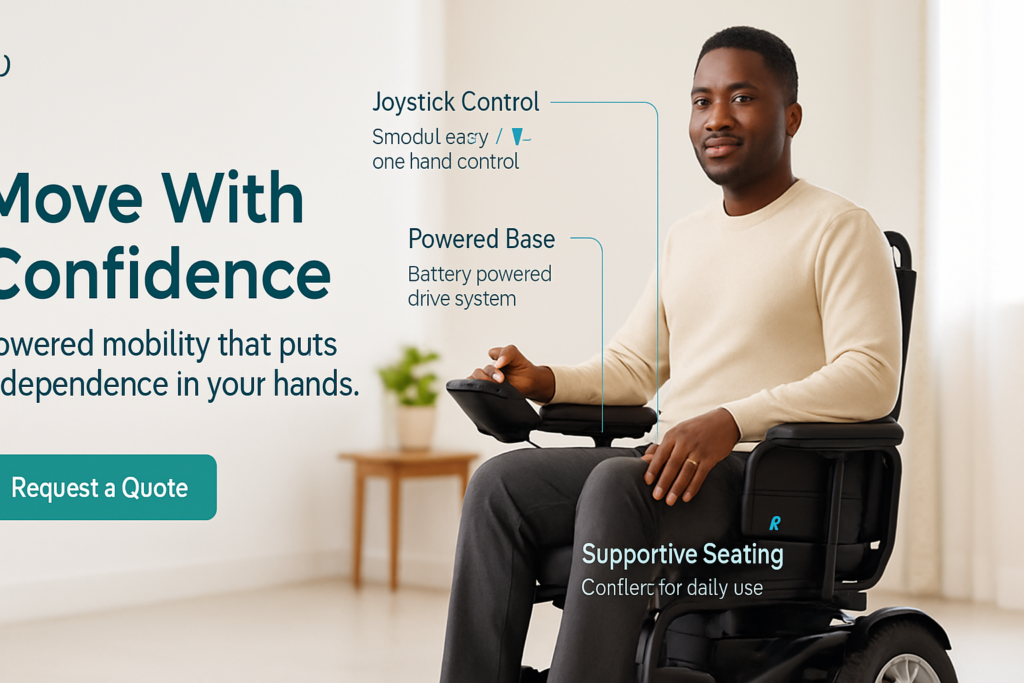
Heavy-Duty Manual vs Electric Wheelchairs
Another major question is whether to choose a manual or powered wheelchair. There is no universal winner. The better option depends on the user’s abilities and environment.
| Feature | Heavy-Duty Manual | Electric Wheelchair |
|---|---|---|
| Power | User or caregiver | Battery-powered |
| Charging | Not required | Required |
| Purchase cost | Generally lower | Generally higher |
| Weight | Often easier to manage | Often heavier |
| Maintenance | Usually simpler | More technical |
| User independence | Depends on physical ability | Can provide powered mobility for appropriate users |
| Transport | Often easier | May require more planning |
| Best consideration | User can safely use manual mobility | User requires powered assistance |
If the user has sufficient upper-body strength and can safely propel the chair, a manual option may be practical. If they cannot propel themselves effectively, a powered wheelchair may be worth considering. But an electric wheelchair also introduces new considerations:
- Battery charging
- Range
- Motor
- Controller
- Maintenance
- Transport
- Indoor turning space
So don’t choose an electric model simply because it looks more advanced. Choose it because the functionality solves a real mobility need.
Bariatric vs Extra-Wide Wheelchair: Are They the Same?
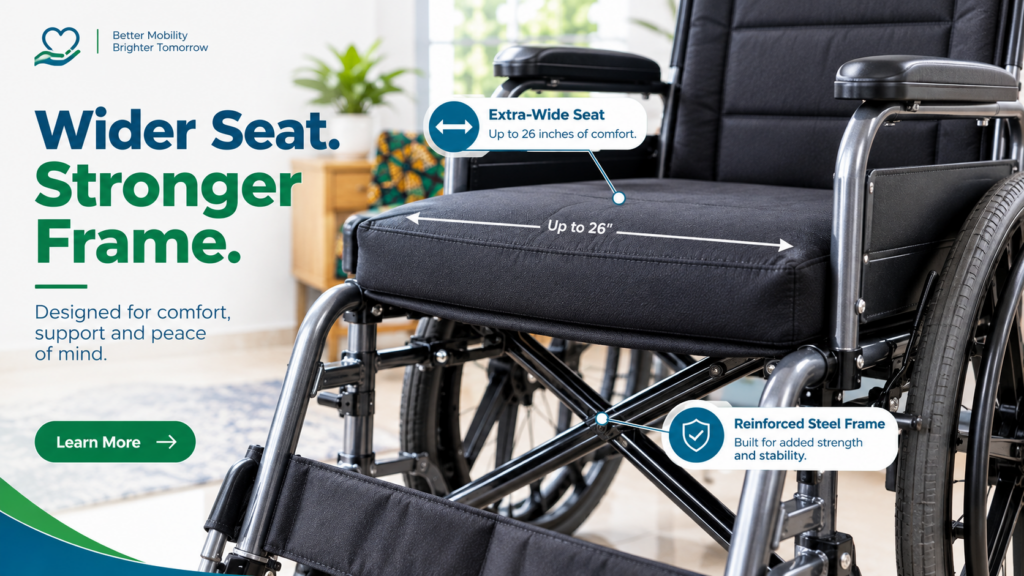
Not necessarily. This is one of the most important distinctions in this article. An extra-wide wheelchair generally refers to the seating width. A heavy-duty wheelchair generally indicates a product designed with higher capacity or more robust construction.
A bariatric wheelchair commonly refers to a wheelchair intended for users requiring greater weight capacity and/or seating space. But these terms can overlap in product marketing. That is why buyers should look beyond the label.
For example: Seat width = How much seating space is available. Weight capacity = How much user weight the wheelchair is designed to support. They are not the same thing. A wider chair does not automatically have a higher load capacity.
Likewise, a high-capacity wheelchair may still have dimensions that do not work well in a particular home. Always check both.
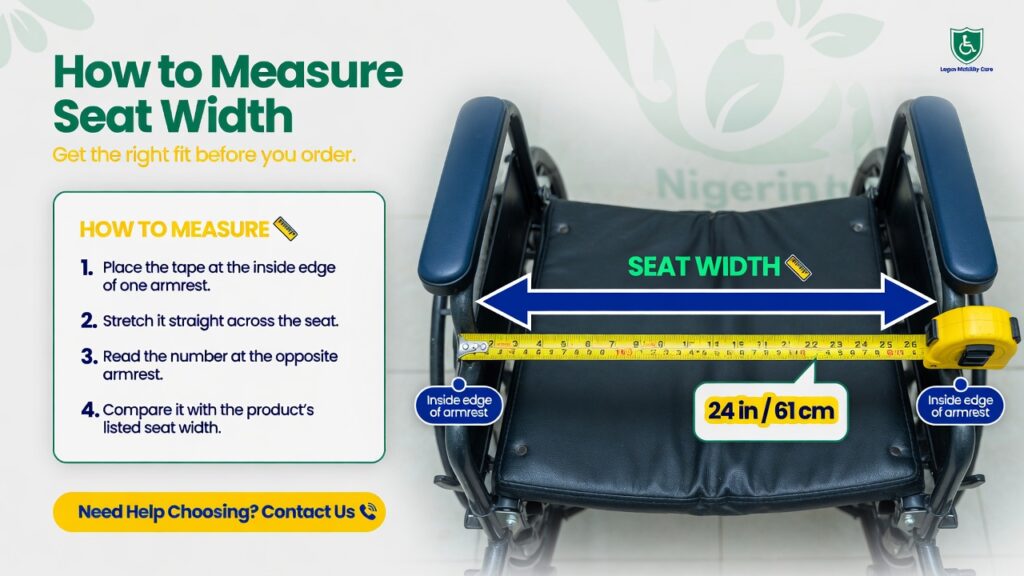
How to Measure for a Bariatric Wheelchair
If you are buying online, measurements become even more important.
Measure the user’s weight
Use a reasonably accurate measurement rather than guessing.
Measure hip width
The user’s body dimensions should be considered when choosing the seat width.
Check seat depth
The seat should suit the user’s body dimensions and seating needs.
Measure doorways
Measure the narrowest entrance the wheelchair needs to pass through.
Check vehicle space
If you plan to transport the wheelchair regularly, measure the vehicle’s available storage area.
Consider turning space
This is particularly important in bedrooms, bathrooms and narrow corridors.
Taking these measurements before ordering can save you from a frustrating return or exchange.
Common Mistakes When Buying a Heavy-Duty Wheelchair
Buying Because It Looks Strong
A thick frame does not tell you the full story. Check the manufacturer’s specifications.
Ignoring the Weight Capacity
Never guess. The actual stated capacity should be one of the first things you check.
Choosing the Widest Chair Automatically
More width is not necessarily better.
The chair should fit the user and the environment.
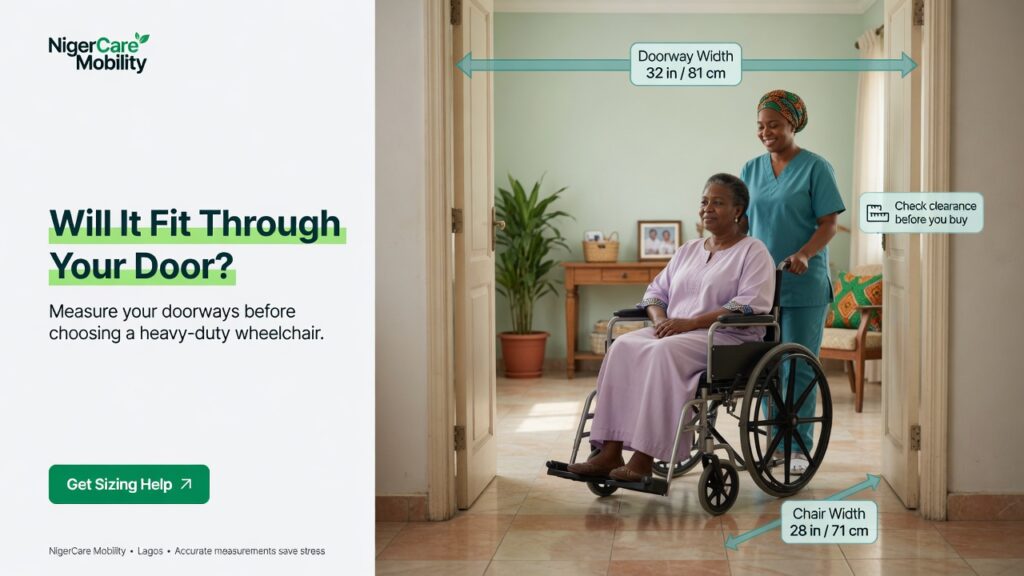
Forgetting Doorway Measurements
This happens more often than you might expect. Measure first. Buy second.
Ignoring the Weight of the Wheelchair
Someone may need a high-capacity chair, but if their caregiver cannot lift it into the vehicle, everyday transportation becomes difficult.
Focusing Only on Price
A lower purchase price can be attractive. However, also consider durability, compatibility, spare parts, warranty and after-sales support.
Assuming Heavy-Duty Means Comfortable
Capacity and comfort are different considerations. The chair still needs appropriate seating dimensions and support.
Buying Without Considering Professional Advice
For users with complex mobility, posture or seating requirements, involve a qualified healthcare professional where possible. WHO recommends four key wheelchair service steps: select, fit, train and follow up. That is a useful way to think about wheelchair purchasing generally.
Where to Buy Heavy-Duty and Bariatric Wheelchairs in Nigeria
Once you know what you need, the next question is where to buy. This is where choosing the supplier matters. A medical equipment supplier should be able to provide clear information about:
- Product specifications
- Weight capacity
- Seat dimensions
- Current availability
- Warranty
- Return conditions
- Replacement parts
- Delivery
- After-sales support
HemacNG currently carries several wheelchair configurations, including standard, commode, cerebral palsy, electric, reclining and executive/reclining models. Its current wheelchair collection is listed online with prices ranging from ₦145,000 for the standard wheelchair to ₦1.5 million for an electric reclining wheelchair, depending on the model. Explore Wheelchairs on HemacNG
However, the current HemacNG wheelchair collection does not by itself establish that every listed model is a bariatric or heavy-duty wheelchair. If you need a specific high-capacity model, confirm the exact weight capacity and dimensions with the supplier before ordering.
That is a much safer approach than assuming that any large-looking wheelchair is suitable. Browse HemacNG Mobility Equipment
Why Choose a Specialist Medical Equipment Supplier?
Buying a wheelchair is different from buying an ordinary household item. The product needs to work for a real person with real mobility requirements. That makes product information and supplier support important.
HemacNG provides medical and mobility equipment and has a wider medical equipment catalogue that allows customers to explore different healthcare products. Shop Medical Equipment on HemacNG When making an enquiry, don’t simply say: “I need a heavy-duty wheelchair.” Instead, provide useful information such as:
- User’s approximate weight
- Required seat width
- Whether the user can walk
- Whether they can propel a manual wheelchair
- Whether a caregiver will push the chair
- Where the chair will be used
- Whether it needs to fit inside a vehicle
- Whether reclining or commode functionality is required
The more information you provide, the easier it becomes to discuss appropriate options. Contact HemacNG About Mobility Equipment
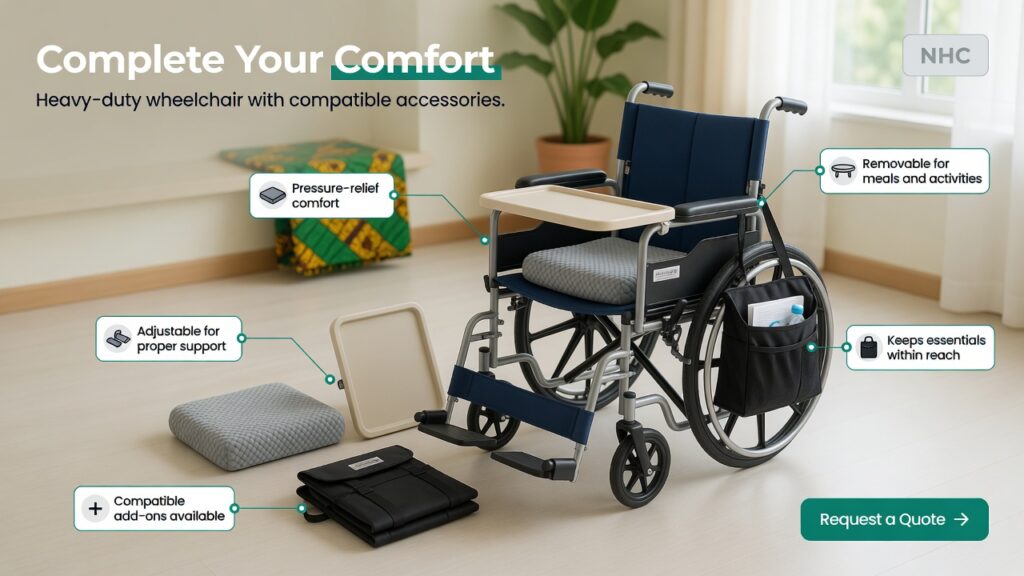
Heavy-Duty Wheelchair Accessories to Consider
The wheelchair itself may only be the beginning. Depending on the model and user’s needs, accessories can improve everyday practicality.
These may include:
- Wheelchair cushions
- Wheelchair trays
- Storage bags
- Footrests
- Leg supports
- Ramps
- Transfer boards
- Replacement wheels
- Rain covers
For example, if the wheelchair is difficult to use at a small entrance step, the problem may not require a different chair. An appropriate ramp could address the access issue.
Likewise, if storage is the challenge, a compatible wheelchair bag may be more practical than replacing the entire wheelchair. For a broader discussion of accessories and mobility products, see our guide to wheelchair accessories and mobility aids in Nigeria.
This is also an important reminder that accessories must be compatible with the wheelchair. Don’t assume that an accessory will fit simply because it is advertised as a “wheelchair accessory.”
What Should You Ask a Supplier Before Buying?
Before paying for a heavy-duty wheelchair, ask these questions:
1. What is the exact maximum user weight?
Get the actual figure.
2. What is the seat width?
Don’t rely on “extra-wide.”
Ask for the measurement.
3. What is the overall width of the wheelchair?
This matters for doorways.
4. How much does the wheelchair weigh?
This matters for transportation.
5. Does it fold?
If yes, ask for the folded dimensions.
6. What are the wheel and brake specifications?
This is particularly useful if the chair will be used frequently.
7. Are replacement parts available?
Ask about wheels, tyres, castors, footrests and other replaceable components.
8. What warranty applies?
Confirm the actual warranty terms for the specific product.
9. What is the return policy?
Read the applicable conditions before ordering.
10. Can the supplier help confirm whether the model suits the user’s requirements?
This is particularly useful when buying online.
Frequently Asked Questions About heavy-duty wheelchairs in Nigeria
How much is a heavy-duty wheelchair in Nigeria?
Prices vary according to capacity, seat width, frame construction, brand and features. Current Nigerian listings include examples around ₦160,000–₦170,000 for some heavy-duty or extra-wide steel models, while a bariatric extra-heavy-duty model is currently listed at ₦550,000 by another supplier.
These should be treated as current examples rather than a fixed national price.
How much is a bariatric wheelchair in Nigeria?
There is no single price. A current Nigerian supplier gives an indicative ₦150,000–₦400,000 range for reclining or bariatric/heavy-duty wheelchairs, while another current listing shows a bariatric extra-heavy-duty model at ₦550,000.
Always confirm the exact model and current price before ordering.
What is the weight capacity of a heavy-duty wheelchair?
It depends on the model. There is no universal capacity for every heavy-duty wheelchair. Check the manufacturer’s stated maximum user weight for the exact model you are considering.
What is the difference between a bariatric and standard wheelchair?
Bariatric wheelchairs are generally designed for users who require greater weight capacity and/or additional seating space. Standard wheelchairs are designed around more typical capacity and dimensions. However, the actual specifications vary by manufacturer and model.
What is the widest wheelchair available in Nigeria?
There is no single universal answer because suppliers stock different models and configurations. Instead of searching only for the widest chair, check the exact seat width alongside the weight capacity and overall wheelchair width.
Are heavy-duty wheelchairs available in Nigeria?
Yes. Current Nigerian suppliers list heavy-duty, extra-wide and bariatric wheelchair options. For example, Waltson Global currently lists heavy-duty and extra-wide steel wheelchairs, while EquipMedMall lists a bariatric extra-heavy-duty wheelchair.
Can a heavy-duty wheelchair fit through a normal doorway?
It depends on the chair’s overall width and the doorway. Measure the narrowest doorway before purchasing, particularly when considering an extra-wide model.
Is a manual or electric heavy-duty wheelchair better?
Neither is automatically better for everyone. A manual wheelchair may suit a user who can safely propel it or has a caregiver available, while powered mobility may be appropriate for someone who cannot effectively propel a manual chair. The user’s abilities and environment should guide the decision.
Can a heavy-duty wheelchair be used outdoors?
Some models can be used outdoors, but suitability depends on the product’s wheel design, construction, terrain and manufacturer specifications. Check the exact model before assuming it is suitable for a particular outdoor environment.
Where can I buy a heavy-duty wheelchair in Nigeria?
You can compare current wheelchair and mobility equipment options from medical equipment suppliers such as HemacNG. For a specific heavy-duty or bariatric requirement, provide the supplier with the user’s weight, desired seat width and intended environment so the available options can be checked. View HemacNG’s Wheelchair Collection
Choose the Right Wheelchair for the Person, Not Just the Price
Buying a heavy-duty wheelchair is not really about finding the biggest chair or the one with the most impressive description. It is about finding equipment that makes sense for a real person’s everyday life. For someone who depends on a wheelchair to move around the house, attend hospital appointments or spend time with family, the right chair can become part of their daily independence.
For a caregiver, the right equipment can make transfers and transportation more manageable. And for the buyer, getting the right specifications before spending money can prevent a frustrating and expensive mistake. So, before buying heavy-duty wheelchairs in Nigeria, remember the simple checklist:
Capacity → Seat width → Fit → Frame → Wheels → Brakes → Environment → Transport → Supplier support.
Don’t buy simply because a product is labelled “heavy-duty.” Check the numbers.
Check the dimensions. Ask questions. And when the user’s needs are complex, seek professional guidance. WHO’s current wheelchair guidance recommends a people-centred process of selecting, fitting, training and following up with wheelchair users.
If you are ready to explore wheelchair options, start by checking the available products and then contact the supplier with the user’s requirements. Shop Wheelchairs on HemacNG. Explore Mobility Aids on HemacNG
If you need help identifying an appropriate option, you can also contact HemacNG directly. Contact HemacNG