

Uncategorized
Best Wheelchairs for Hospitals and Home Care in Nigeria (2026 Guide)
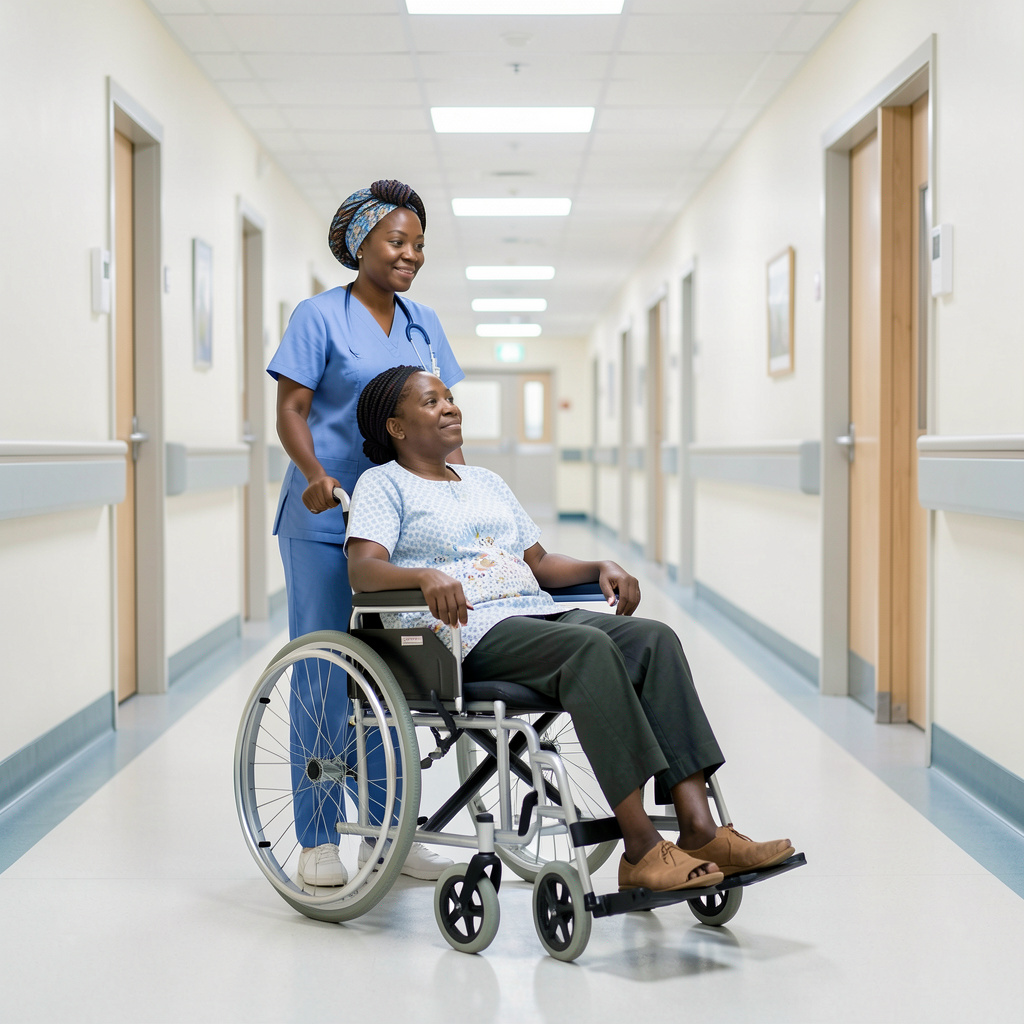
The complete 2026 guide to the best wheelchairs for hospitals and home care in Nigeria, for clinic owners, ward managers, and families who need straight answers, not sales talk. Emeka had been managing the procurement for a private hospital in Abuja for six years.
He knew how to negotiate prices. He knew how to read supplier invoices.
So when his hospital opened a new rehabilitation ward and needed twelve wheelchairs urgently, he did what seemed reasonable. He found a supplier online with competitive prices and decent-looking product photos. He placed the order. The wheelchairs arrived in four days, which felt like a win.
Within the first week, two of the twelve chairs had brakes that engaged unevenly. One had a footrest that wouldn’t lock into position. And three had weight capacity ratings that, on closer inspection, had been printed on stickers rather than stamped into the frame, which meant nobody actually knew what those chairs could safely support.
No patient was seriously hurt. But Emeka spent the next three weeks returning chairs, arguing with an unresponsive supplier, and sourcing replacements under pressure. His rehabilitation ward opened two weeks late.
The problem wasn’t that he bought wheelchairs. The problem was that nobody had given him a reliable guide to what the best wheelchairs for hospitals and home care in Nigeria actually look like and what to check before a single naira changes hands.
This guide exists to fix that. Whether you’re a procurement officer outfitting a ward, a clinic owner equipping a maternity unit, or a family member navigating the deeply stressful task of finding the right chair for a parent recovering from a stroke at home, you’ll find the honest, specific answers here that most suppliers in Nigeria would rather you didn’t have. Let’s get into it.
Why Choosing the Best Wheelchair in Nigeria Is More Complicated Than It Looks
Here’s something that doesn’t get said enough in Nigerian healthcare conversations: the wheelchair market in this country is almost entirely unregulated at the retail level.
What that means in practice is that a medical-grade, clinically appropriate wheelchair and a home-use decorative chair with a higher price tag can sit on the same online listing page, described with almost identical language, and most buyers have no reliable way to tell them apart until something goes wrong.
The World Health Organization’s wheelchair service delivery guidelines are clear on what appropriate wheelchair provision requires: a proper assessment of the user’s condition, the correct matching of device to clinical need, and products that meet verifiable quality standards. These guidelines exist because the consequences of getting wheelchair selection wrong are not abstract.
Power supply affects electric wheelchair performance. An electric wheelchair is genuinely life-changing for the right patient. But if your area experiences eight to twelve hours of daily power outages and the chair’s battery lasts six hours on a full charge, you need to know the backup charging options before you commit to that investment.
Humidity and heat accelerate deterioration. Nigeria’s climate is unforgiving to untreated steel frames. A wheelchair with inadequate anti-rust treatment will begin showing visible corrosion within months, which is both a professional embarrassment for clinical facilities and a structural safety concern for patients.
The setting determines everything. And this is the point that matters most: the best wheelchair for a hospital ward and the best wheelchair for home care in Nigeria are rarely the same product. They serve different environments, different users, and different daily demands, and they require different specifications.
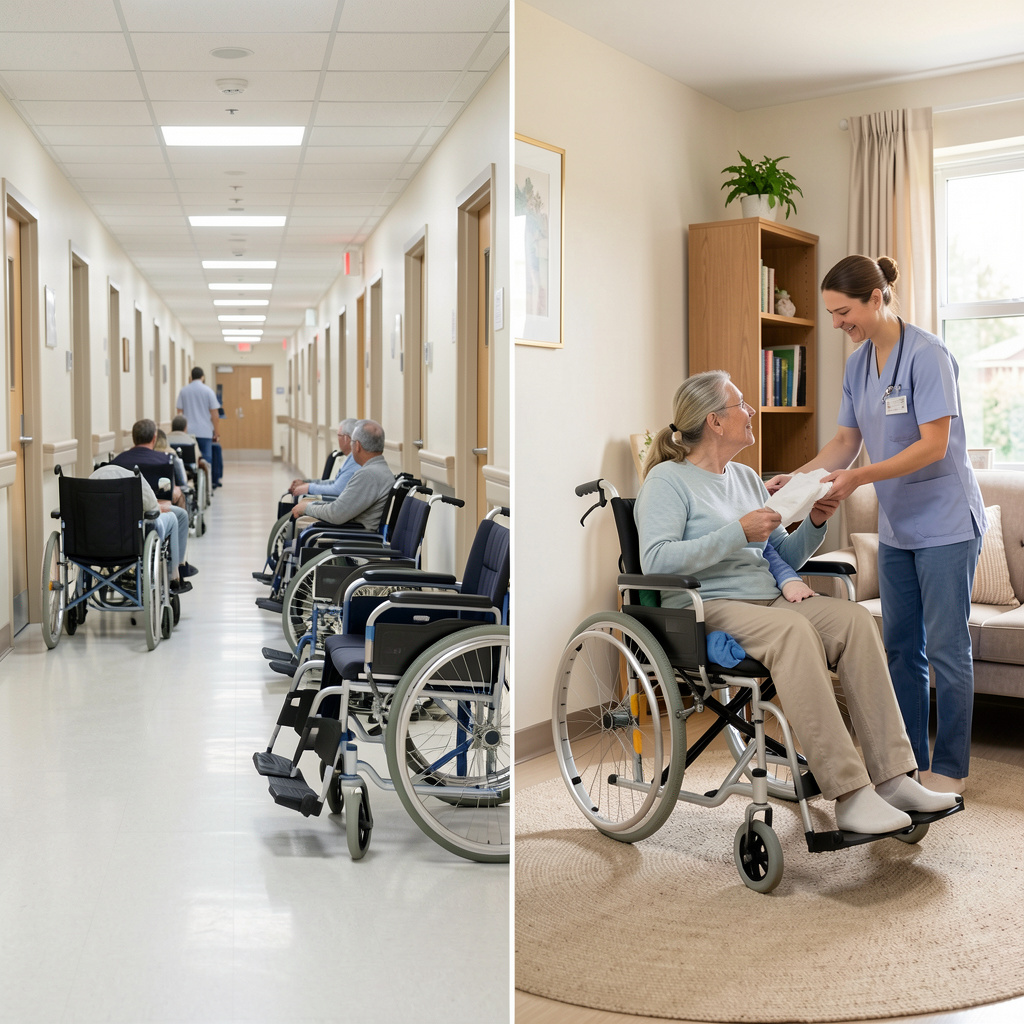
The Best Wheelchairs for Nigerian Hospitals: What Every Ward Actually Needs
Let’s start with the clinical environment, because this is where the consequences of a wrong decision are most immediate and most serious.
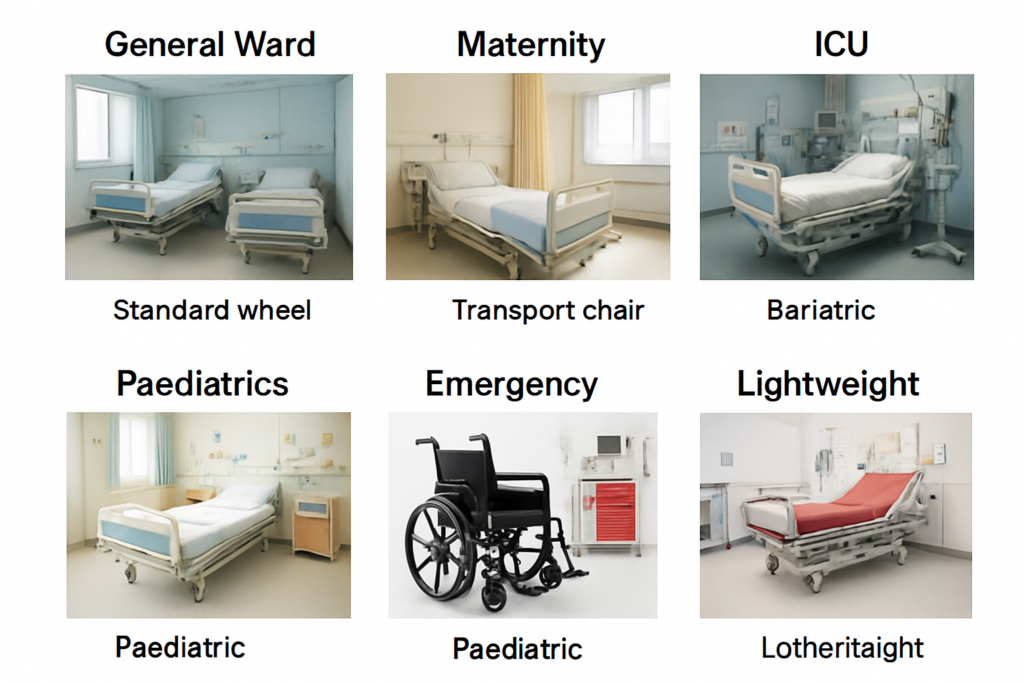
Different hospital departments have genuinely different wheelchair requirements, and treating them as interchangeable is one of the most common and costly procurement mistakes Nigerian hospital managers make.
For General Hospital Wards
The workhorse of any Nigerian hospital’s wheelchair fleet is the standard manual wheelchair. It needs a steel or aluminium frame with a minimum weight capacity of 120 kg, an anti-rust coating appropriate for Nigerian humidity, padded armrests, foot pedal brakes that engage firmly, and a foldable design that allows for efficient storage between uses.
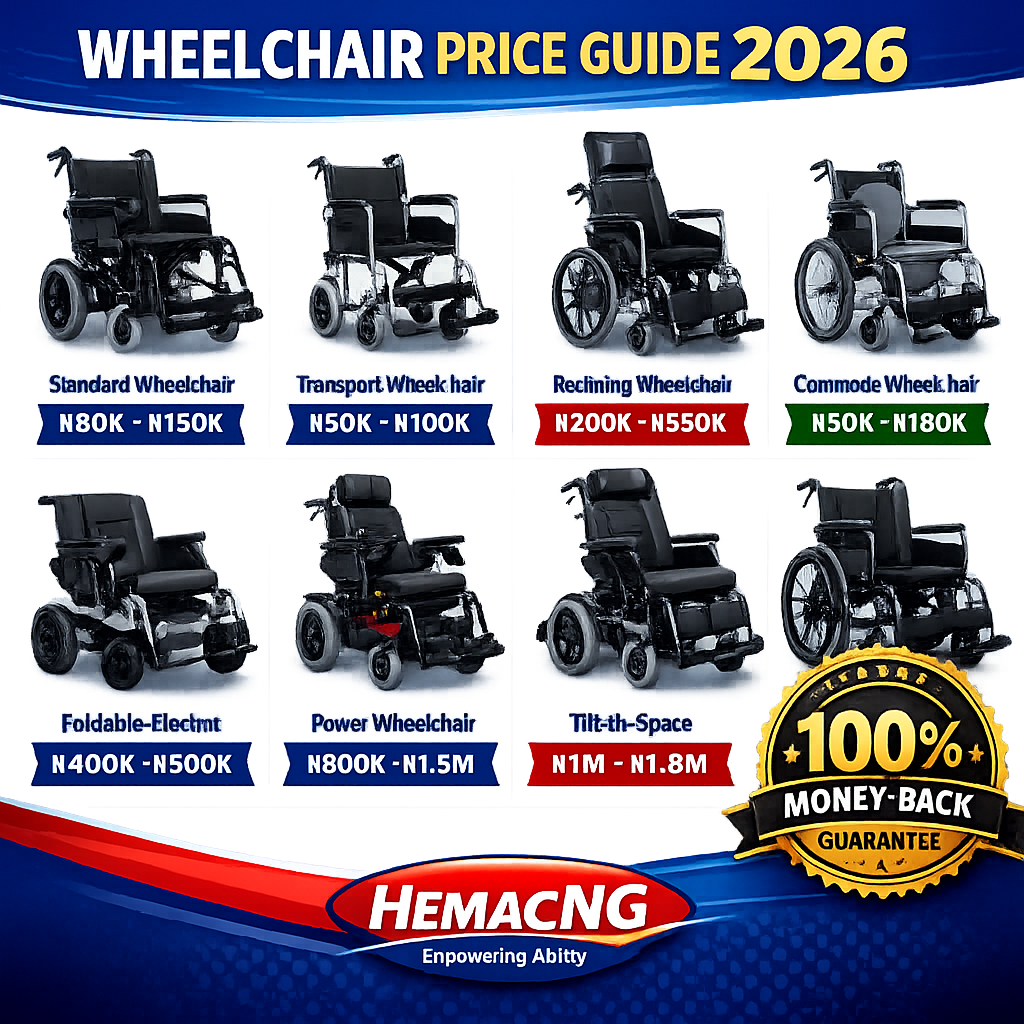
This is the chair your nursing staff will interact with multiple times every shift. Durability is non-negotiable. A chair that begins showing frame fatigue within six months of daily ward use isn’t a cost saving; it’s a procurement failure with potential liability attached. Realistic price range: ₦45,000 – ₦120,000 for medical-grade options
For Maternity and Obstetric Units
Maternity units need two things working in parallel: a standard manual wheelchair for moving labouring and post-delivery patients comfortably and a commode wheelchair for post-caesarean patients who cannot safely transfer to a separate toilet facility without clinical support.
The commode wheelchair eliminates a genuinely dangerous transfer manoeuvre that causes avoidable injury to both post-surgical patients and the nurses assisting them. For any maternity home or obstetric unit in Nigeria that doesn’t yet have commode-wheelchairs, this is the most urgent procurement gap to address. Easy-clean, anti-microbial surfaces are critical for infection control in maternity settings. Removable armrests allow for safe lateral patient transfer from bed to chair. Realistic price range: ₦60,000 – ₦180,000
For ICU and High-Dependency Units
Patients in intensive care and high-dependency settings frequently cannot maintain an upright seated position for extended periods. For these patients, a standard manual wheelchair is clinically inappropriate; it provides insufficient postural support and increases pressure injury risk.
The correct choice is a reclining wheelchair with a fully adjustable backrest, elevating leg rests, and a seat cushion that distributes pressure appropriately. The backrest should recline to near-horizontal for patients with very limited upright tolerance, and locking rear wheels are essential for safe positioning during nursing procedures.
For Paediatric Wards
This is where Nigerian hospitals most consistently get it wrong, and the consequences are the most uncomfortable to witness.
Standard adult wheelchairs are not clinically appropriate for children. The seat dimensions, weight distribution, postural support systems, and safety features are designed for adult bodies. Using an adult wheelchair for a child in a paediatric ward is not a temporary solution, it is a clinical risk that should be eliminated as a priority.
Paediatric wheelchairs feature correctly proportioned frames, adjustable components that accommodate growth, safety harness options for children with limited postural control, and lightweight designs that are manageable for nursing staff and family caregivers alike.
For Emergency and Surgical Units
Emergency patient transfer demands structural reliability under physical stress and precise directional control. The wheelchair used in an emergency bay or surgical transfer corridor needs locking front castors, a high weight capacity, minimal complex moving parts that could fail under pressure, and a frame robust enough to handle repeated fast transfers without structural fatigue.
A heavy-duty standard manual wheelchair with reinforced joints and a confirmed weight rating is the appropriate specification. This is not the place to economize on frame quality.
The Best Wheelchairs for Home Care in Nigeria: What Families and Caregivers Actually Need
Now let’s shift completely, because the home care context requires a different kind of thinking entirely.
When a family member comes home from the hospital in a wheelchair, the clinical precision of the ward environment disappears. What replaces it is the real, complicated, emotionally charged landscape of a Nigerian home, narrow corridors, bathroom doorways that weren’t built with wheelchair access in mind, family members who are loving but not clinically trained, and a patient who is simultaneously grateful for support and quietly devastated by needing it.
The best wheelchair for home care in Nigeria has to work in that real environment. Not just technically. Humanly.
For Elderly Family Members at Home
The most practical choice for most Nigerian families caring for an elderly relative is a lightweight transport wheelchair. The reasoning is straightforward: elderly patients being cared for at home are typically pushed by a family member who is not a medical professional. A heavy wheelchair exhausts the caregiver. An exhausted caregiver makes mistakes. Mistakes in wheelchair management cause falls.
A lightweight transport wheelchair, ideally under 12 kg for the chair itself, reduces caregiver physical strain significantly, folds compactly enough to store in a standard Nigerian bedroom, and is narrow enough to navigate the tighter doorways common in older Nigerian homes.
Before ordering, measure the narrowest doorway in your home and compare it to the chair’s listed width. This single check prevents one of the most frustrating and costly wheelchair return situations. HemacNG’s procurement team encounters regularly.
For Stroke Patients at Home
Post-stroke home care is one of the most emotionally complex caregiving situations a Nigerian family can face, and wheelchair selection is genuinely more nuanced here than for any other condition.
Stroke patients with unilateral weakness, weakness on one side of the body, may benefit significantly from a standard manual wheelchair with a one-arm drive option, which allows the patient to propel themselves using their unaffected arm. This preserves a degree of independence that has measurable psychological benefits for stroke recovery, according to clinical research referenced through PubMed’s stroke rehabilitation literature.
For patients with more limited upright tolerance, a reclining wheelchair provides the adjustable positioning they need for extended sitting periods. Removable armrests are essential for safe lateral transfer from bed to chair, which will happen multiple times daily.
For Post-Surgery Recovery at Home
Post-surgical patients recovering at home typically have more time-limited wheelchair needs, weeks to a few months rather than years. The priority is a chair that is comfortable for daily use, easy to fold for transport to follow-up appointments, and appropriate for the patient’s current physical capacity.
For patients with upper body strength intact, a self-propelled wheelchair gives them meaningful independence during recovery.
For Children with Disabilities at Home
Parents of children living with cerebral palsy, congenital mobility conditions, or significant injury-related disabilities face a specific challenge: their child’s needs will change as they grow, and a poorly chosen wheelchair can become obsolete, or worse, harmful, within a year.
The best home-care wheelchair for a disabled child in Nigeria is a paediatric model with growth-adjustment features, adjustable seat depth, width, and footrest height that can be reconfigured without replacing the entire frame. Washable seat covers are a practical necessity for Nigerian home care settings.
7 Things to Check Before You Buy Any Wheelchair in Nigeria
Before we talk about where to buy, let’s talk about what to verify, regardless of which supplier you’re considering. Because the best wheelchair for hospitals and home care in Nigeria is only as good as the pre-purchase checks that confirm it was right for your specific patient.
1. Confirm the weight capacity against the patient’s actual body weight.
Never estimate. Never assume. Get the patient’s weight, find the chair’s rated maximum capacity in the product specifications, and confirm there is a comfortable margin between the two numbers.
2. Ask explicitly about frame material and anti-rust treatment.
In Nigeria’s humidity, untreated steel frames begin rusting within months of regular use. Medical-grade wheelchairs use powder-coated steel or aluminium alloy frames. Ask for this specification in writing before ordering.
3. Measure the patient’s seated hip width before ordering.
A seat that is too narrow causes pressure sores on the outer thighs within days. A seat that is too wide prevents effective self-propulsion and causes the patient to lean to one side. Measure the patient’s hip width while they are seated and compare it to the chair’s listed seat width.
4. Consider the wheel type for your specific terrain.
Pneumatic tyres absorb shock from uneven surfaces but require inflation maintenance. Solid tyres need no maintenance but transmit more vibration.
5. Test the brake system before accepting delivery.
Both the caregiver and any patient-operated hand brakes should engage firmly and release cleanly in a single motion. A brake that requires two attempts to engage is a brake that will eventually fail to engage at all.
6. Request SON compliance documentation for any clinical purchase.
This single document confirms the product has been evaluated against Nigerian regulatory safety standards. Any legitimate medical equipment supplier should provide it without hesitation.

Why HemacNG Is Nigeria’s Most Trusted Source for Hospital and Home Care Wheelchairs
HemacNG has built its position as Nigeria’s most trusted medical equipment supplier not through marketing language but through consistent, verifiable delivery on what matters most to healthcare providers and families: genuine products, expert guidance, reliable delivery, and the confidence to back every purchase with an unconditional guarantee.
Here’s what that looks like concretely: Every wheelchair is genuinely medical-grade and clinically certified. HemacNG sources exclusively from verified manufacturers whose products meet Nigerian regulatory standards through SON and international quality benchmarks referenced by NAFDAC.
A 2-year warranty covers every purchase. If something goes wrong within two years of your purchase, a structural issue, a component failure, or a brake system problem, HemacNG stands behind it. You don’t fight for this coverage. It’s standard.
A 100% money-back guarantee protects every order. This is the assurance that Emeka in Abuja needed before he placed that first order. If your wheelchair arrives and it doesn’t match what was ordered, doesn’t perform to the clinical standard you required, or simply isn’t right for your patient’s specific condition, HemacNG refunds your complete payment.
Free procurement consultation is available before you buy. HemacNG’s team will work through your clinical requirements, your patient’s specific condition, your home or facility environment, and your budget, and recommend the right wheelchair before you commit to anything.
Browse HemacNG’s complete wheelchair collection and the full range of hospital furniture and mobility equipment that Nigerian healthcare facilities trust.
HemacNG Wheelchair Delivery Across Nigeria: Fast, Verified, and Fully Guaranteed
Delivery anxiety is entirely legitimate for Nigerian online buyers. So let’s be specific rather than vague. HemacNG delivers wheelchairs across all 36 states, including:
Lagos | Abuja | Port Harcourt | Kano | Enugu | Uyo | Ibadan | Warri | Benin City | Kaduna | Abeokuta | Owerri | Calabar | Asaba | Jos | Ilorin | Maiduguri | Sokoto | Akure | Lokoja | Awka | Ado-Ekiti | Bauchi | Damaturu | Gusau | Jalingo | Lafia | Makurdi | Minna | Yola | Birnin Kebbi | Dutse | Gombe | Umuahia | Yenagoa
- Standard Delivery: 3–7 working days nationwide
- Express Delivery: 24–48 hours available in select major cities for urgent clinical needs
- Bulk and Institutional Orders: Custom logistics scheduling to align with facility timelines
Every delivery is covered by HemacNG’s 100% money-back guarantee. If what arrives at your door doesn’t match your order, your money returns in full — whether you’re in Victoria Island or a semi-rural area of Nasarawa State.
For international buyers and diaspora investors, HemacNG ships to:
🇬🇭 Ghana | 🇨🇲 Cameroon | 🇸🇱 Sierra Leone | 🇱🇷 Liberia | 🇬🇲 Gambia | 🇿🇦 South Africa | 🇦🇪 UAE | 🇬🇧 UK | 🇺🇸 USA
Shipping options include air freight for urgent orders, sea freight for bulk cost-effective shipments, and consolidated cargo for mixed equipment orders. Full export documentation, customs clearance support, and secure palletized packaging are handled entirely by HemacNG’s logistics team.
Your Questions About the Best Wheelchairs for Nigerian Hospitals and Home Care, Answered
What is the best wheelchair for a Nigerian hospital ward?
For general wards, a standard manual wheelchair with an anti-rust frame and a minimum 120 kg capacity. For ICU and HDU settings, a reclining wheelchair with an adjustable backrest and elevating leg rests.
How much does the best hospital wheelchair cost in Nigeria in 2025?
Medical-grade hospital wheelchairs range from ₦45,000 for standard manual models to ₦280,000 for reclining ICU-appropriate options. Bulk institutional discounts are available through HemacNG’s procurement team.
Which wheelchair is best for a stroke patient recovering at home in Nigeria?
A reclining wheelchair for patients with limited upright tolerance, or a standard manual wheelchair with one-arm drive capability for patients with unilateral weakness who want to maintain partial independence during recovery.
Does HemacNG offer a money-back guarantee on wheelchair purchases?
Yes, unconditionally. HemacNG’s 100% money-back guarantee on returns after purchase applies to every wheelchair on the platform.
Can I get a wheelchair delivered anywhere in Nigeria?
Yes. HemacNG delivers to all 36 Nigerian states with standard delivery of 3–7 working days and express options in major cities. Every delivery is backed by the full money-back guarantee.
What is the best electric wheelchair for home use in Nigeria?
An electric wheelchair with a minimum eight-hour battery runtime and backup charging capability is best suited to Nigerian home conditions. Contact HemacNG to discuss specific models with battery specifications appropriate for your area’s power supply situation.
How do I confirm a wheelchair is SON-compliant in Nigeria?
Request the SON certification documentation from your supplier before payment. HemacNG provides this documentation with every wheelchair purchase as a standard part of the order, not an optional extra.
The Best Wheelchair Is the One That Gives Someone Their Life Back
Here’s what this entire guide comes down to. When Emeka in Abuja finally sourced the right wheelchairs for his rehabilitation ward, medical-grade, correctly specified, properly delivered, backed by a genuine warranty, and an unconditional money-back guarantee—something changed in that ward. Patients moved safely. Staff worked without anxiety about equipment failure.
That’s what the best wheelchairs for hospitals and home care in Nigeria actually accomplish when chosen correctly. Not just clinical compliance. Not just procurement satisfaction. Something more human than either of those things.
Choose the right wheelchair for your hospital or your home. Choose HemacNG, because their 100% money-back guarantee isn’t just a policy. It’s a promise that what you receive will be exactly what the person waiting for it deserves.
Ready to Find the Best Wheelchair for Your Hospital or Home Care Need?
You now have everything you need to make the right decision, without guessing, without risking the wrong product, and without the kind of experience Emeka had in Abuja. Shop the Best Wheelchairs for Hospitals & Home Care at HemacNG.com, Request a Free Quote or Bulk Order Consultation, Speak with a HemacNG Wheelchair Specialist Today. Have a specific clinical question about wheelchair selection for a particular patient, condition, or facility type? Leave it in the comments below or reach out to the HemacNG team directly. Whether you’re equipping a single room in a family home or an entire rehabilitation wing, the right wheelchair is one informed conversation away, and every purchase you make is fully protected.


Tulisannya jelas dan mudah dipahami. Lanjutkan kontennya gan!
Setuju banget dengan poin-poin di sini. Recommended untuk yang lagi cari referensi.
Setuju banget dengan poin-poin di sini. Recommended untuk yang lagi cari referensi.
Informasi yang dibutuhkan banyak orang. Bookmark dulu untuk dibaca ulang.
Setuju banget dengan poin-poin di sini. Recommended untuk yang lagi cari referensi.
Setuju banget dengan poin-poin di sini. Recommended untuk yang lagi cari referensi.
Tulisannya jelas dan mudah dipahami. Lanjutkan kontennya gan!
Test, message – Thank you!