
Uncategorized
Where to Buy Wheelchairs in Nigeria (2026 Prices, Types & Delivery Guide)

The honest 2026 guide on where to buy wheelchairs, types, real prices, and fast delivery across Nigeria, for families, caregivers, and healthcare providers who deserve straight answers
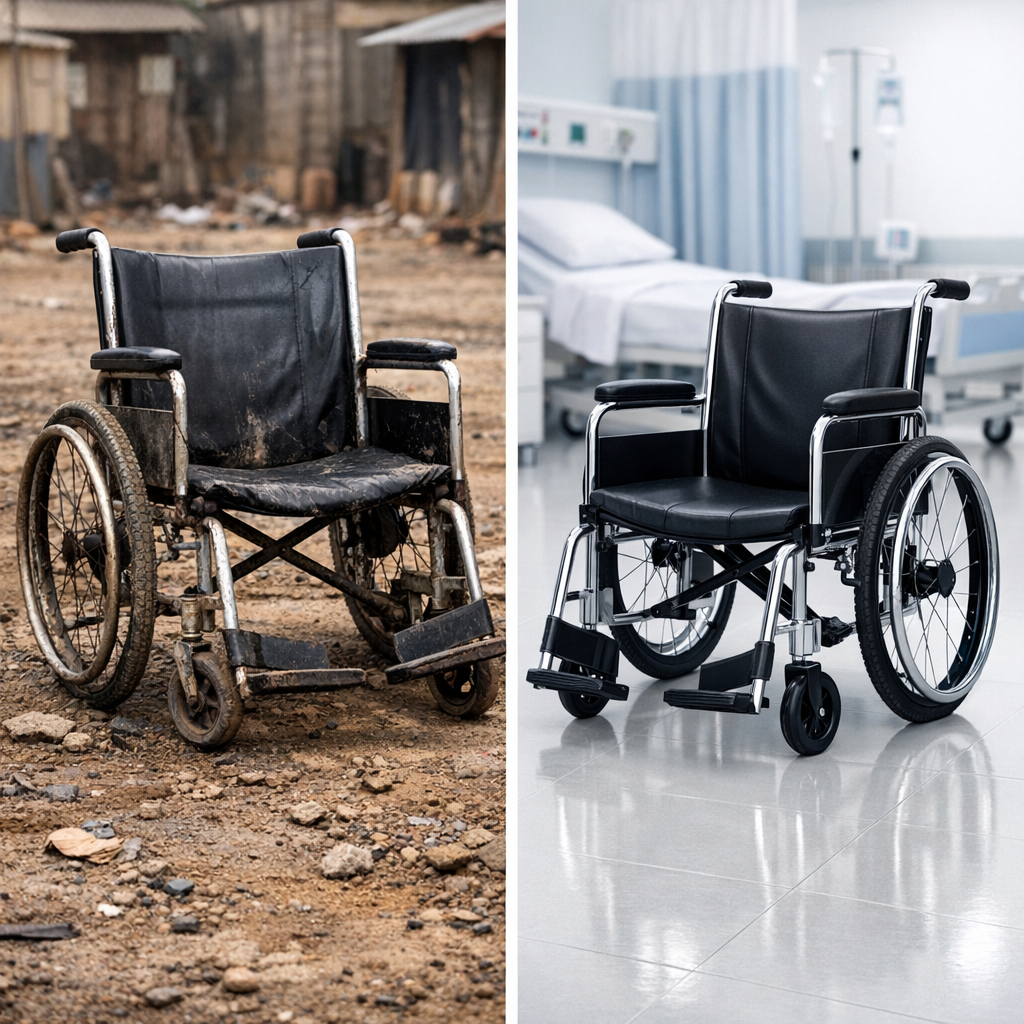
It was past midnight when Ngozi finally closed her laptop in frustration. Her mother had suffered a mild stroke three weeks earlier. The doctors had cleared her for discharge, but the house wasn’t ready. The passage was too narrow for the borrowed wheelchair from a neighbour. The bathroom needed rails. And the wheelchair itself, a flimsy, rusted thing that wobbled on one wheel, was clearly never designed for someone who would be sitting in it for eight or more hours a day.
So Ngozi searched. She typed “where to buy wheelchairs in Nigeria” into Google and spent three hours clicking through pages of contradictory prices, Instagram vendors with no physical address, and marketplace listings that offered zero clinical information about whether the product was actually built for medical use. By midnight, she hadn’t placed a single order. She was exhausted, confused, and more worried about her mother than when she started.
Does that sound familiar? Because if you’re reading this right now, there’s a good chance you’re somewhere in Ngozi’s shoes. Maybe it’s a parent. Maybe it’s a patient in your clinic.
Whatever your situation, this guide exists to give you the one thing Ngozi couldn’t find that night: a clear, honest, and complete answer to where to buy wheelchairs in Nigeria in 2025, including real prices, every type explained simply, and delivery options that actually make sense. Let’s get into it together.
Why Buying the Right Wheelchair in Nigeria Is a Medical Decision, Not Just a Shopping One
Before we talk about prices and suppliers, there’s something important worth understanding first.
A wheelchair is not furniture. It is not a convenience item you can afford to guess on. The World Health Organization’s wheelchair service delivery guidelines are very clear on this: the wrong wheelchair, used for the wrong patient, in the wrong environment, causes real clinical harm. In Nigeria specifically, these risks are compounded by factors that most generic buying guides completely ignore:
Terrain matters. A lightweight transport wheelchair that performs beautifully on smooth hospital floors can become a dangerous and exhausting challenge on the uneven surfaces common in Nigerian homes and outdoor spaces.
Power supply matters. An electric wheelchair is life-changing for the right patient, but if it requires charging every six hours and your area experiences eight-hour power cuts, you need a model with robust battery backup before you make that investment.
Body weight matters. Purchasing a standard model for a larger patient creates structural failure risks that are both dangerous and expensive.
Clinical condition matters. A stroke patient with left-side weakness needs a very different wheelchair configuration than a child with cerebral palsy or a post-amputation patient beginning rehabilitation.
The point is this: when you’re figuring out where to buy wheelchairs in Nigeria, the supplier you choose should be able to guide you through these decisions, not just hand you a product and collect payment.
That’s the difference between a medical equipment partner and a market vendor. And that difference matters enormously.
Every Type of Wheelchair Available in Nigeria — Explained Simply
One of the most overwhelming parts of this search is encountering wheelchair categories without any explanation of who they’re actually for. So let’s fix that right now, in plain language.
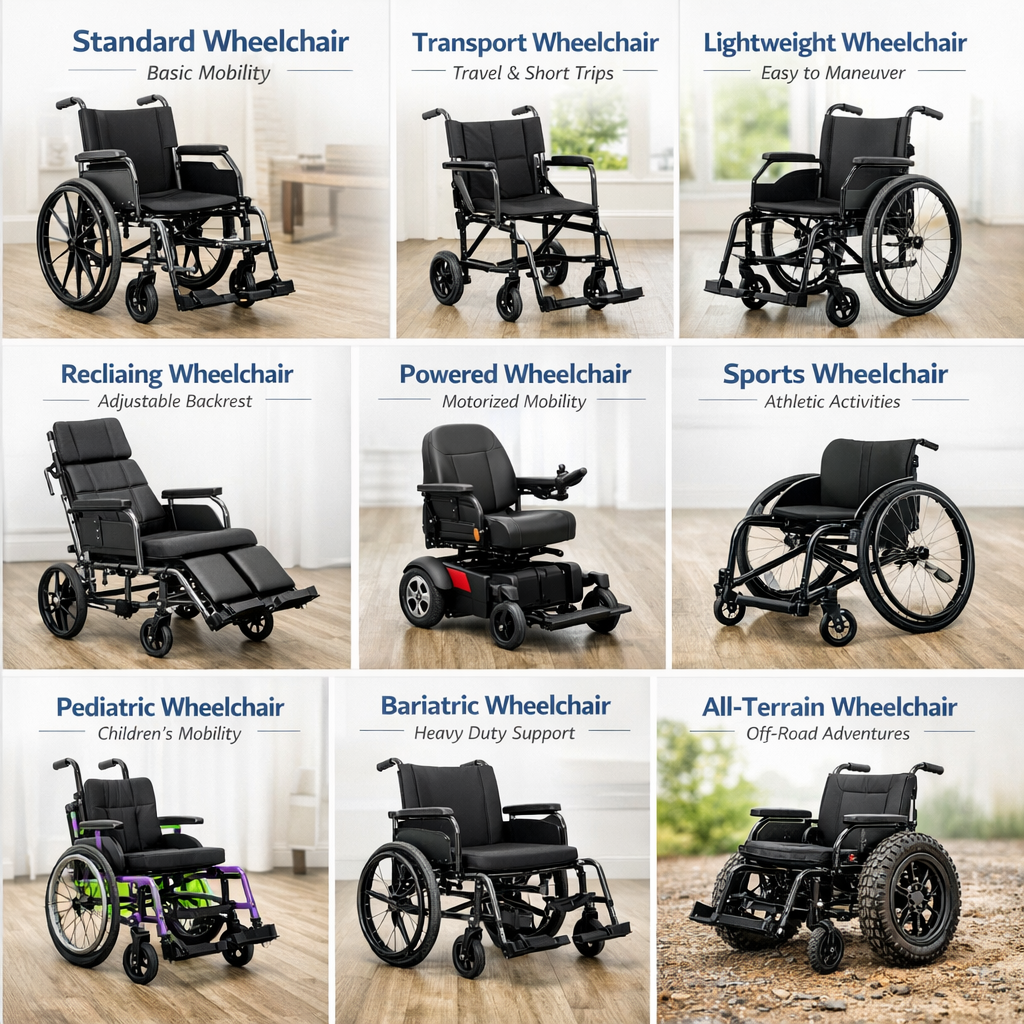
Standard Manual Wheelchair
This is the most common type you’ll find in Nigerian hospitals and clinics. It has a steel frame, foldable design, push handles for caregivers, and standard-sized rear wheels. It works well for general mobility needs, short-term post-surgical recovery, and clinic patient transport. If you’re equipping a general ward or outpatient clinic, this is typically your starting point.
Lightweight Transport Wheelchair
It’s lighter, folds more compactly, and is considerably easier to load into a car. It’s ideal for families managing elderly relatives during hospital visits, outings, or routine check-ups where portability matters as much as function.
Self-Propelled Wheelchair
This model has larger rear wheels fitted with hand rims that allow the patient to push themselves independently without caregiver assistance. Think of it as the wheelchair of choice for active users living with lower limb conditions who refuse to let a disability define their daily movement.
Reclining Wheelchair
For patients who cannot maintain an upright seated position for extended periods, the reclining wheelchair is not just preferable, it’s essential. The backrest adjusts through a range of angles, and the leg rests elevate to support circulation and reduce pressure on the lower spine.
Electric/ Motorized Wheelchair
Battery-powered and joystick-controlled, the electric wheelchair is genuinely transformative for patients with limited or no upper body strength. For quadriplegic patients, individuals with advanced muscular dystrophy, or elderly people who want to live independently without depending on a caregiver for every movement, it provides a level of autonomy that no manual model can replicate.
Paediatric Wheelchair
Built specifically for children, these models feature smaller frames, adjustable components that accommodate natural growth over time, and optional safety harnesses for children with limited postural control.
Bariatric Wheelchair
A reinforced, wider wheelchair engineered for patients with higher body weight, typically supporting between 150kg and 250kg or more depending on the specific model. This is not a category where approximation is acceptable.
Commode Wheelchair
This multifunctional model combines a wheelchair and a toilet chair in one unit, featuring a removable seat pan positioned over an opening in the seat. It eliminates the need to transfer a patient from a wheelchair to a toilet, which is particularly valuable in hospital wards, maternity homes, and home care settings where patients have very limited mobility and transfer presents genuine injury risk for both patient and caregiver.
Wheelchair Prices in Nigeria 2026: The Honest Numbers
Here is a realistic, transparent breakdown of wheelchair prices in Nigeria in 2025, based on medical-grade, certified products from verified suppliers:
| Wheelchair Type | Price Range (₦) | Best For |
| Standard Manual Wheelchair | ₦45,000 – ₦120,000 | General clinic and home use |
| Lightweight Transport Wheelchair | ₦55,000 – ₦130,000 | Family caregiving, hospital visits |
| Self-Propelled Wheelchair | ₦70,000 – ₦180,000 | Independent active users |
| Reclining Wheelchair | ₦120,000 – ₦280,000 | Post-stroke, long-term care |
| Electric/Motorized Wheelchair | ₦350,000 – ₦900,000 | Severe mobility restriction |
| Paediatric Wheelchair | ₦65,000 – ₦160,000 | Children with disabilities |
| Bariatric Wheelchair | ₦150,000 – ₦350,000 | High weight capacity needs |
If you find a manual wheelchair listed online for ₦18,000 or ₦20,000, please stop and ask yourself one straightforward question: what corners were cut to arrive at that price? Because corners were absolutely cut somewhere. Substandard frames crack under the daily physical stress of real use.
And here is something worth knowing before you place your order anywhere: HemacNG offers a 100% money-back guarantee on returns after purchase. If your wheelchair arrives and it doesn’t meet the standard you ordered it to whether that’s a quality issue, a specification mismatch, or a product that simply isn’t right for your patient’s needs, HemacNG will refund you completely. No lengthy disputes. No conditions buried in fine print. Your money comes back to you in full, unconditionally.
That guarantee is rare in the Nigerian medical equipment market.
For bulk and institutional pricing, request a personalized quote from HemacNG directly, significant discounts are available for hospitals, clinics, rehabilitation centres, and NGO procurement.
Where to Buy Wheelchairs in Nigeria: An Honest Comparison of Every Option Available to You
Alright. This is the section you came for. So let’s be completely honest about every channel available to Nigerian wheelchair buyers in 2025.
Open Markets and Physical Medical Stores
Places like Idumota in Lagos, Onitsha Main Market, and Kano Central Market carry wheelchair options, and pricing is typically negotiable with enough patience. However, here’s the clinical reality that market vendors will never tell you: the majority of wheelchair products sold in these environments are not manufactured to medical specifications. There is no warranty. There is no SON compliance documentation. And there is absolutely no way to verify whether the product you’re purchasing will still hold together six months from now under daily patient use.
For a short-term, light-use scenario with a genuinely constrained budget, market options might serve a temporary purpose. For any patient who depends on a wheelchair as their primary means of daily mobility, the risk is simply too high to justify.
Instagram and Facebook Vendors
Social media has become a surprisingly active channel for wheelchair sales in Nigeria, and some vendors operating through these platforms are legitimate small businesses with genuine imported products. However, a meaningful number are not. The fundamental problem is unverifiable accountability, no confirmed physical address, no documented warranty, no demonstrable clinical expertise, and in many cases, no reliable way to receive a response after payment has left your account.
If you choose to purchase through social media regardless, at minimum confirm a verifiable physical address, request documented SON compliance certification, and insist on a written warranty before any funds are transferred.
General E-Commerce Marketplaces
Platforms like Jumia and Konga offer buyer protection frameworks and a wider accountability structure than direct social media purchases, which makes them meaningfully safer as a channel. However, they remain general-purpose marketplaces rather than medically specialized platforms. You will not receive clinical guidance on wheelchair selection, professional advice on matching device to patient condition, installation support, or any form of after-sales clinical servicing. The quality and expertise of the seller behind any given listing varies enormously and is rarely transparent.
Verified Medical Equipment Suppliers
This is where the entire equation changes.
A verified, medically specialized equipment supplier like HemacNG brings something that no market vendor, social media page, or general marketplace can authentically offer: genuine clinical accountability, backed by expertise, backed by a guarantee.
Every wheelchair on HemacNG’s platform is sourced from verified manufacturers, meets SON compliance standards and international quality benchmarks referenced by NAFDAC, carries a documented warranty, and is supported by a team that genuinely understands the clinical context behind your purchase.
And critically, every purchase is protected by HemacNG’s 100% money-back guarantee on returns. If you receive a product that doesn’t match what you ordered, or that doesn’t perform to the clinical standard you need, HemacNG returns your money in full. That level of commitment to the buyer is what separates a genuine healthcare partner from everyone else in this market.
When Ngozi finally found HemacNG and called their procurement line, someone walked her through the practical difference between a transport wheelchair and a self-propelled model for her mother’s specific post-stroke condition, the corridor dimensions of their home in Lagos, and the daily weight her mother’s chair would need to support reliably. She placed her order with full confidence, and her wheelchair arrived within four working days. Her mother sat in it for the first time and exhaled. That’s the difference a verified, expert supplier makes.

Why Hundreds of Nigerian Families, Clinics, and Hospitals Trust HemacNG for Wheelchairs
By now you have a clear picture of the landscape. So let’s talk specifically about what makes HemacNG the consistent answer to where to buy wheelchairs in Nigeria for thousands of buyers across the country every single year.
Here is what that looks like in practice: Every product is genuine and medically certified. No grey-market imports. No counterfeit frames. HemacNG sources exclusively from verified manufacturers whose products meet Nigerian regulatory standards through SON and international quality benchmarks referenced by NAFDAC.
A 2-year warranty protects your investment. This is genuinely uncommon in the Nigerian wheelchair market. It means that if anything goes wrong within two years of your purchase, HemacNG stands behind it both operationally and financially, without requiring you to fight for it.
A 100% money-back guarantee protects every purchase. This is HemacNG’s clearest statement of confidence in their products. If your wheelchair doesn’t perform as specified, or if it arrives and isn’t right for your patient’s needs, you receive a complete refund. No partial returns. No store credits are offered instead of your money. A full, unconditional refund. This guarantee covers every wheelchair purchase on the platform, and it exists because HemacNG has enough confidence in what they sell to back it without conditions.
Clinical procurement consulting is genuinely available. Not sure which wheelchair type suits your patient’s specific condition, weight, or home environment? HemacNG’s specialists will work through the decision with you, factoring in diagnosis, daily usage patterns, caregiver availability, terrain, and budget.
International shipping supports diaspora investors and families. If you’re a Nigerian living in the UK, USA, or UAE and you need to send a quality wheelchair to a family member back home or equip a healthcare facility you’re investing in remotely, HemacNG manages the entire logistics chain from procurement through to doorstep delivery.

How to Choose the Right Wheelchair for Your Patient or Loved One
Even with all the information above clearly laid out, choosing between eight wheelchair types can still feel uncertain, particularly when the decision involves someone you care deeply about. So here is a simple, practical framework to guide you through it:
Start with the diagnosis. Post-stroke patients with unilateral weakness typically do well with a standard manual or reclining wheelchair, depending on their tolerance for upright positioning. Children with cerebral palsy need paediatric models with postural support systems. Quadriplegic patients require electric models with appropriate joystick configurations. Patients recovering from amputation may need specialized footrest arrangements on a self-propelled chair. The diagnosis is always your first filter.
Consider the environment where the chair will be used most. Indoor home use in a typical Nigerian house calls for a compact, manoeuvrable wheelchair that can navigate tight corridors and doorways. Outdoor use across uneven terrain requires a more robust frame and reliably stable wheels. Clinical ward use day after day typically suits standard manual or commode models built for high-frequency institutional use.
Be completely honest about body weight. This is one of the most consistently overlooked factors in Nigerian wheelchair purchases, and the consequences of getting it wrong are serious. Always confirm the patient’s actual weight against the wheelchair’s specified maximum capacity before ordering. Never assume a standard model will be adequate without checking the specifications explicitly.
Have a conversation before you commit. Especially for patients with complex conditions, a five-minute conversation with HemacNG’s procurement team can protect you from a costly and potentially harmful mismatch. They have guided hundreds of buyers through exactly this process, the consultation costs nothing, and every recommendation they make is backed by the full money-back guarantee.
Wheelchair Delivery in Nigeria: How Fast Can You Actually Get It?
Delivery anxiety is completely understandable in Nigeria, and for reasons that don’t need explaining to anyone who has ordered anything online here. So let’s be entirely specific about what HemacNG actually delivers, and how quickly.
Nationwide Delivery Across All 36 States:
Lagos, Abuja, Port Harcourt, Kano, Enugu, Uyo, Ibadan, Warri, Benin City, Kaduna, Abeokuta, Owerri, Calabar, Asaba, Jos, Ilorin, Maiduguri, Sokoto, Akure, Lokoja, Makurdi, Minna, Yola, Birnin Kebbi, Dutse, Gombe, Umuahia, Yenagoa, and all 36 states
- Standard Delivery: 3–7 working days nationwide
- Express Delivery: 24–48 hours available in select major cities for genuinely urgent orders
- Bulk and Institutional Orders: Custom logistics scheduling to align with your facility’s renovation or launch timeline
And remember, every delivery is backed by HemacNG’s 100% money-back guarantee on returns. If what arrives doesn’t match what you ordered, your money comes back. That assurance applies whether you’re in Lagos Island or a semi-rural area of Plateau State.
For international buyers, HemacNG ships to:
🇬🇭 Ghana | 🇨🇲 Cameroon | 🇸🇱 Sierra Leone | 🇱🇷 Liberia | 🇬🇲 Gambia | 🇿🇦 South Africa | 🇦🇪 UAE | 🇬🇧 UK | 🇺🇸 USA
International shipping options include air freight for urgent clinic setups, sea freight for bulk cost-effective orders, and consolidated cargo shipments for mixed equipment and furniture orders. Full export documentation, customs clearance support, and secure palletized packaging are handled entirely by HemacNG’s logistics team, so you don’t have to navigate that complexity alone.
Your Wheelchair Questions, Answered Completely
Where can I buy a wheelchair in Nigeria?
You can buy verified, medical-grade wheelchairs in Nigeria at HemacNG.com, with nationwide delivery available across all 36 states, international shipping to the UK, USA, Ghana, and several other countries, and a 100% money-back guarantee on every purchase.
Can I buy a wheelchair online in Nigeria with home delivery?
Absolutely. HemacNG offers secure online ordering with standard nationwide delivery of 3–7 working days and express delivery options available in major cities for urgent needs. Every order is fully covered by HemacNG’s money-back guarantee.
What is the best wheelchair for an elderly person in Nigeria?
For most elderly Nigerians who need full caregiver assistance, a lightweight transport wheelchair is the most practical and comfortable option. For elderly individuals who retain upper-body strength and want to maintain independence, a self-propelled model is more appropriate.
Is there an electric wheelchair for sale in Nigeria?
Yes. HemacNG stocks electric and motorized wheelchairs with prices starting from ₦350,000. Battery backup specifications for areas with inconsistent power supply are available on request, and the full money-back guarantee covers all electric wheelchairs.
Does HemacNG offer a money-back guarantee on wheelchairs?
Yes, unconditionally. HemacNG offers a 100% money-back guarantee on returns after purchase. If your wheelchair doesn’t arrive as described, doesn’t match the clinical specifications you ordered, or simply isn’t right for your patient’s needs, HemacNG refunds your full payment without conditions, complications, or delays.
Does HemacNG offer bulk wheelchair orders for hospitals and NGOs?
Absolutely. HemacNG provides bulk order discounts, institutional procurement support, and complete documentation for hospitals, government facilities, rehabilitation centres, and NGOs across Nigeria. Contact HemacNG’s procurement team to discuss your facility’s specific requirements.
A Wheelchair Is More Than Equipment — And You Already Know That
Here’s the truth that nobody actually says out loud during this kind of search. When you’re looking for where to buy wheelchairs in Nigeria, you are not simply shopping. You are searching for a way to give someone you love, or someone in your care, something back. Their movement. Their independence. To attend a grandchild’s naming ceremony without needing four people to carry them. To move from a hospital bed to a window and watch the world outside, on their own terms, without waiting for someone else to make it possible. That is not a small thing. It is, in the most genuine sense, everything.
The mother who can wheel herself to the kitchen in the morning before anyone else is awake. The young man who can return to his office three months after his accident, navigating corridors in a chair that actually supports him properly. The clinic patient who arrives at the theater on a sturdy, stable wheelchair that doesn’t wobble or threaten to fold beneath them mid-transfer.
HemacNG has helped hundreds of Nigerian families, clinics, and hospitals navigate exactly this decision. They understand the clinical requirements. They understand the emotional weight. And they deliver, literally and in every other meaningful sense, on the promise that your purchase will be exactly what you needed it to be, or your money comes back in full. Because the person waiting for that wheelchair deserves nothing less than your best decision.

Ready to Find the Right Wheelchair in Nigeria — With Zero Risk?
You now have everything you need to make a genuinely confident, fully informed decision. The next step is straightforward. Shop All Wheelchairs on HemacNG.com. Speak with a HemacNG Mobility Equipment Specialist Today. Every wheelchair purchased through HemacNG is covered by a 100% money-back guarantee on returns after purchase. If your order doesn’t arrive as described or doesn’t meet the clinical standard you needed, you receive a complete refund, no conditions, no complications, no delay. Shop with total confidence.
Have a question about a specific wheelchair type, your patient’s clinical condition, delivery timelines, or bulk pricing? Leave it in the comments below or reach out to the HemacNG team directly.