
Uncategorized
Best Infant Radiant Warmer in Nigeria 2026 Guide
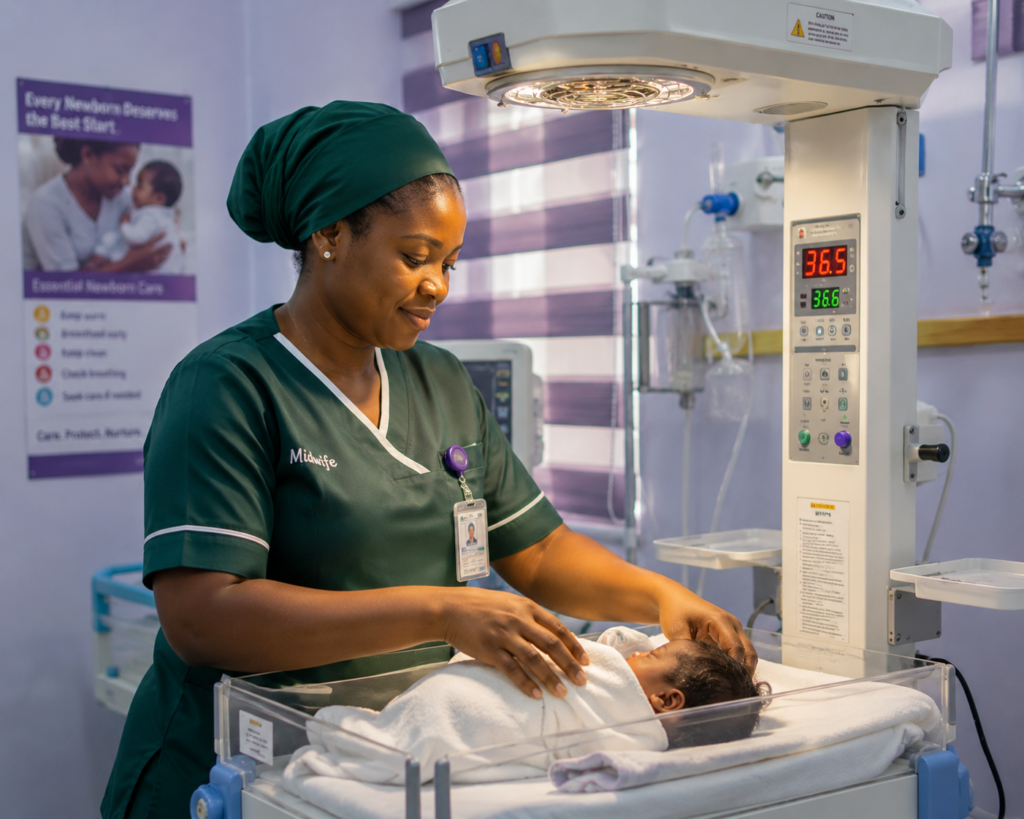
The baby arrived blue and limp. It had been a difficult emergency caesarean section in a busy Nigerian hospital. As soon as the surgeon lifted the baby from the uterus, the midwife rushed him to the radiant warmer. Within seconds, warm light flooded his tiny body.
The monitor beeped, staff worked quickly, and a few long moments later, a weak cry filled the room. That radiant warmer did not “save” him alone. Yet without it, the team would have been fighting hypothermia as well as breathing and circulation. If you run a maternity centre, labour ward, theatre, or NICU in Nigeria, you already know this feeling: those first minutes after birth are critical. Deciding which equipment stands between a premature or low‑birth‑weight baby and the harsh room air is not a cosmetic choice. It is a survival decision. This is why choosing the best infant radiant warmer in Nigeria for your facility matters so deeply.
In this guide, we’ll walk through:
- Why infant radiant warmers are essential for newborn survival
- How they work (in simple terms you can explain to your team)
- The features that separate an average unit from the best infant radiant warmer in Nigeria
- 2026 price ranges in naira
- How to choose the right model for your specific facility
- Where to buy SON‑aligned infant radiant warmers in Nigeria, with proper installation and support
Throughout, we’ll reference HemacNG, a trusted medical equipment supplier that delivers neonatal equipment across all 36 states.
Why Infant Radiant Warmers Are So Critical for Newborn Survival
Newborns, especially preterm or low‑birth‑weight babies, lose heat at an alarming rate. Their skin is thin, they have almost no fat, and their bodies are not yet good at regulating temperature.
The World Health Organization warns that neonatal hypothermia is a major contributor to early newborn deaths, even in warm countries. You can read more in their guidance on newborn thermal protection.
In many Nigerian hospitals and clinics, the delivery room may be crowded, air‑conditioned, or exposed to draughts. When a wet baby is placed on a cold metal trolley or under a fan, their temperature can drop quickly. Hypothermia leads to:
- Low blood sugar
- Breathing difficulties
- Poor oxygenation
- Higher risk of infection
- Greater mortality, especially for fragile preterm infants
An infant radiant warmer tackles this problem head‑on. It keeps the newborn’s body at a safe temperature while allowing staff full access for:
- Drying and stimulation
- Suctioning
- Resuscitation (bag and mask, or T‑piece)
- Umbilical line placement
- Examination and Apgar scoring
That combination of warmth plus open access is why no serious newborn unit should be without at least one radiant warmer, and why investing in the best infant radiant warmer in Nigeria is not a luxury purchase.
What Is an Infant Radiant Warmer and How Does It Work?
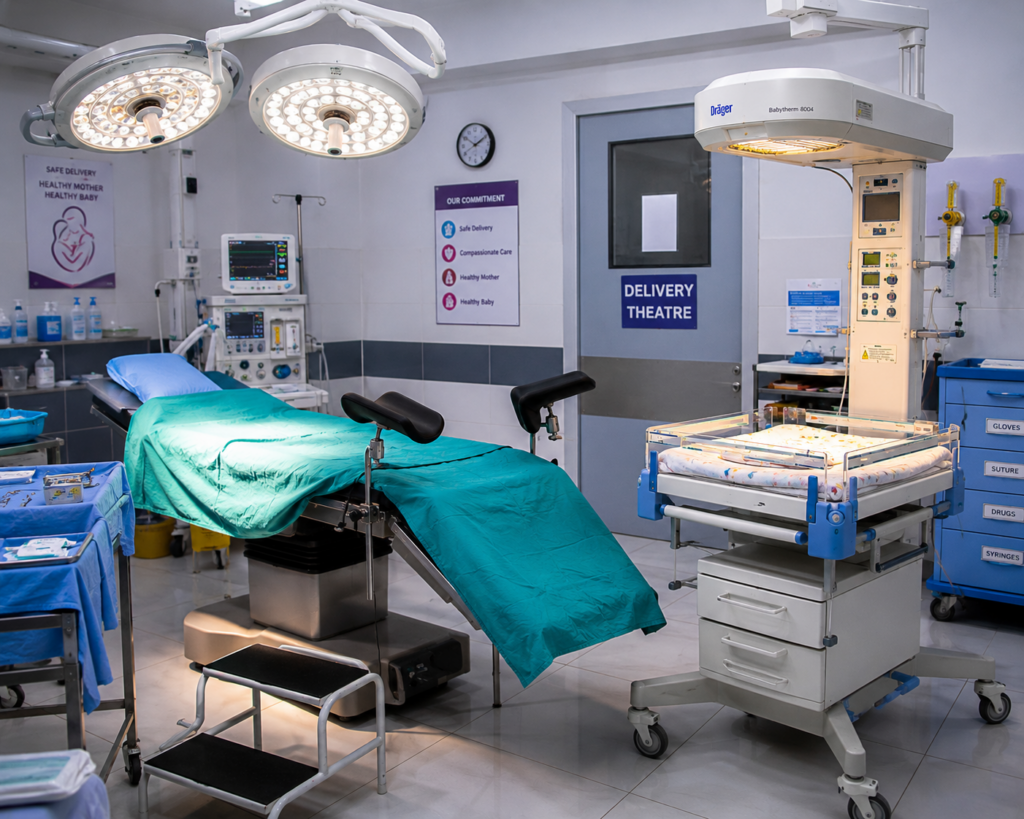
At its core, an infant radiant warmer is a specialised open bed with an overhead heating unit and a control system.
Here’s how it works in simple language:
- Overhead heat source
A radiant heater (often using quartz or infrared elements) sits above the baby and directs warmth downward. - Baby platform
The newborn lies on a firm, flat mattress or tray that can support resuscitation and procedures. - Temperature sensors
- Air mode (manual): staff set a fixed output based on air temperature.
- Servo mode (skin control): a skin probe attached to the baby’s torso feeds temperature data to the controller, which adjusts heat to keep the baby at a set target temperature.
- Control panel and alarms
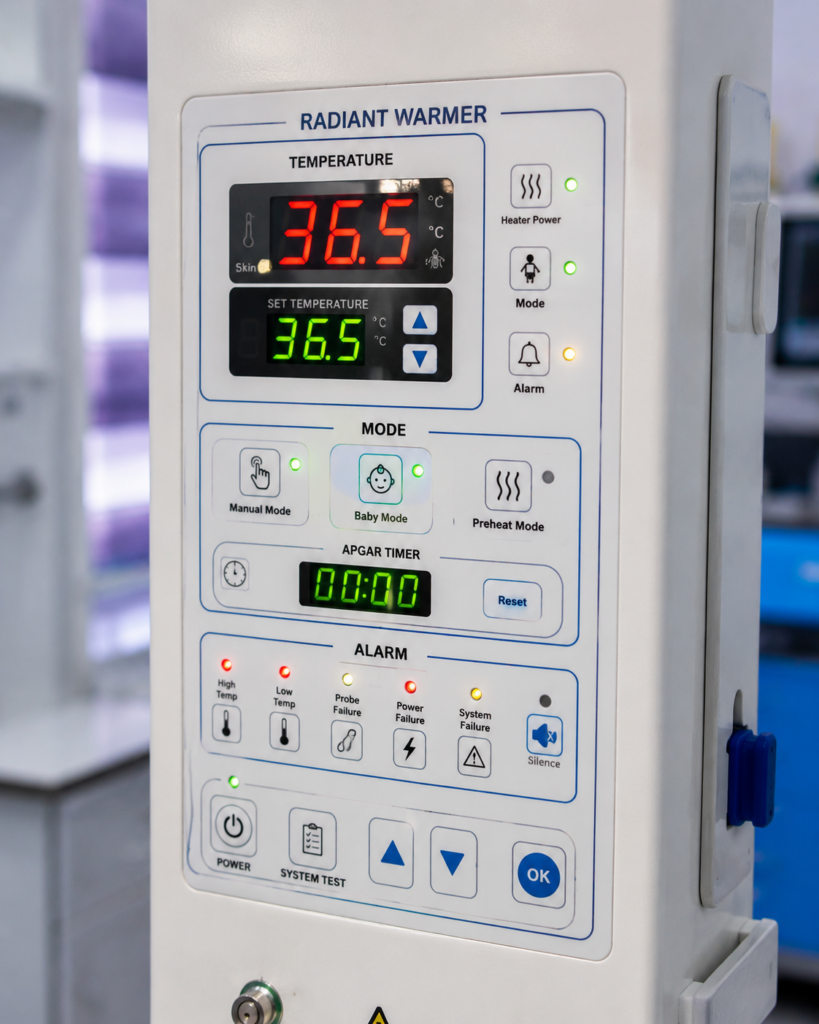
Digital displays show current and target temperatures. Alarms alert staff if the baby’s skin gets too warm, the probe falls off, or the heater malfunctions.
Because the baby is not enclosed, staff can quickly perform resuscitation, line insertion, and examination without opening doors or lifting a lid, unlike an incubator. That makes an infant radiant warmer ideal for:
- Delivery rooms
- Operating theatres (for caesarean sections)
- Neonatal resuscitation corners
- NICUs where frequent procedures are needed
Incubators still have their place for longer‑term, controlled environments, but when seconds count and hands‑on access is vital, the best infant radiant warmer in Nigeria becomes the front‑line tool.
Key Features to Look For in the Best Infant Radiant Warmer in Nigeria
Not all warmers are created equal. When Nigerian hospitals, private maternity centres, and NGOs evaluate neonatal equipment, they increasingly look for certain features that distinguish the best infant radiant warmer in Nigeria from basic models.
Let’s break those down.
1. Precise Heating Technology and Temperature Control
Look for:
- Reliable heating elements with even heat distribution
- Both manual and servo operating modes
- Accurate skin probes with clear placement instructions
Servo control is especially important for preterm babies. In this mode, the warmer adjusts output automatically based on the baby’s skin temperature, helping prevent both hypothermia and overheating.
2. Safety Alarms and Monitoring
Safety alarms are not optional in a high‑risk environment. The best infant radiant warmer in Nigeria should include:
- Over‑temperature alarm
- Skin probe disconnection or displacement alarm
- System fault indicator
- Optional integration with SpO₂ and heart‑rate monitors in advanced units
These alerts help staff respond immediately when something goes wrong — which, in a busy ward, can happen at any time.
3. Easy Access for Procedures
Remember that many babies under radiant warmers will need the following:
- Resuscitation
- Intubation
- Umbilical line insertion
- Phototherapy or intravenous therapy
For this reason, look for:
- Open, unobstructed access from all sides
- Tilting mattress or Trendelenburg capability (head up/down)
- Sliding or pull‑out trays for equipment
In emergency situations, cramped or awkward designs slow your team down.
4. Integrated Resuscitation Features (For Higher‑Level Facilities)
Some advanced warmers combine thermal support with built‑in resuscitation systems. Features can include:
- Apgar timer
- Oxygen blender
- Suction
- Positive‑pressure resuscitator (bag and mask or T‑piece system)
These are often used in tertiary hospitals and high‑acuity NICUs. While they cost more, they reduce equipment clutter at the resuscitation station and speed up response.
5. Build Quality and Durability
Nigeria’s environment is demanding. Humidity, dust, and frequent cleaning products all take a toll.
Durable units typically have:
- Rust‑resistant metal frames
- High‑quality casters (wheels) with secure brakes
- Surfaces that clean easily with hospital‑grade disinfectants
Because infant radiant warmers are a long‑term investment, the best infant radiant warmer in Nigeria must stand up to years of continuous use.
6. Power Requirements and Backup
Most medical equipment in Nigeria must cope with an unstable power supply. When evaluating warmers, consider:
- Voltage compatibility (220–240 V AC at 50 Hz)
- Power consumption (important for generator and inverter sizing)
- Behaviour after power cuts: does it restart safely?
For critical neonatal equipment, a small dedicated UPS or connection to an inverter system is strongly recommended. The additional cost is minor compared to the risk of a warmer shutting down unexpectedly during a resuscitation.
Types of Infant Radiant Warmers Available in Nigeria
When Nigerian healthcare decision-makers start looking for the best infant radiant warmer in Nigeria, they quickly discover that there are different categories, each with its own profile.
Basic Infant Radiant Warmers
These units typically include:
- Overhead heater
- Manual and servo temperature modes
- Baby platform with side rails
- Basic audible and visual alarms
They suit:
- Small private clinics
- Maternity homes
- Low‑acuity delivery rooms with modest budgets
Warmers with Integrated Resuscitation Units
These combine warming with:
- Oxygen blender
- Suction
- T‑piece resuscitator or bag‑and‑mask system
- Apgar timer
They are ideal for:
- General hospitals
- High‑volume delivery suites
- NICUs that want full resuscitation capability at the bedside
Warmers with Phototherapy Attachments
In facilities facing frequent neonatal jaundice, space is often limited. Some radiant warmers have:
- Overhead phototherapy lamps
- Under‑bed phototherapy units
These allow simultaneous warming and jaundice treatment, saving both time and floor space.
Mobile Versus Fixed Warmers
- Mobile warmers on wheels can move between theatres, delivery rooms, and NICUs. This is common in many Nigerian settings.
- Fixed warmers may be built into specific delivery suites. These work in purpose‑built units but require planned layouts.
HemacNG supplies a range of these configurations. You can see examples in their neonatal and NICU equipment section or request a catalogue through the contact page.
Infant Radiant Warmer Prices in Nigeria (2026 Guide)
Understanding price bands helps you budget and spot unrealistic quotations.
Here is a general 2026 price guide for infant radiant warmers in Nigeria (actual numbers depend on brand, features, and currency rates):
| Type of Radiant Warmer | Typical Use | Approx. Price Range (₦) |
|---|---|---|
| Basic infant radiant warmer | Small clinics, maternity homes | 1,200,000 – 3,000,000 |
| Warmer with basic resuscitation kit | General hospitals, larger centres | 2,500,000 – 5,500,000 |
| Advanced warmer with full resuscitation features | Tertiary hospitals, busy NICUs | 4,500,000 – 9,000,000+ |
| Radiant warmer with integrated phototherapy | NICUs treating jaundice frequently | 3,500,000 – 8,000,000+ |
Prices fluctuate with:
- Exchange rates
- Shipping and customs
- Warranty length and service agreements
When purchasing critical devices like this, pay attention not only to the base price but also:
- Whether installation is included
- Training for your staff
- Availability of spare parts
For accurate quotes tailored to your facility, you can request a neonatal equipment proposal from HemacNG. Their team can help you balance budget with features, without compromising safety.
How to Choose the Best Infant Radiant Warmer in Nigeria for Your Facility
Selecting the best infant radiant warmer in Nigeria is not just about picking the most sophisticated model. It is about matching your facility’s reality with the right specifications.
Here’s a practical framework.
1. Consider Your Facility Level
- Primary clinic or small maternity home
- May need 1 basic warmer in the delivery room.
- Focus on reliability and ease of use.
- Secondary hospital or high‑volume maternity centre
- Often requires multiple units: one in theatre, one or two in delivery rooms, and one in NICU.
- At least one warmer with resuscitation features is highly recommended.
- Tertiary centre, teaching hospital, or established NICU
- Needs several advanced warmers with integrated resuscitation and monitoring.
- Phototherapy attachments may be necessary where space is tight.
2. Estimate Delivery Volume and Risk Profile
- How many births per month?
- What proportion are preterm or complicated deliveries?
- Do you accept referrals for high‑risk pregnancies?
The higher the volume and risk, the stronger the case for advanced models and redundancy (more than one unit).
3. Evaluate Space and Layout
- Measure room sizes and plan traffic flow.
- Consider positions near oxygen supply, suction points, and power outlets.
- Ensure there is enough clearance for staff to work all around the warmer.
4. Assess Power Infrastructure
- Do you have a stable main supply?
- Are there inverters, UPS, or generators in place?
- Can neonatal equipment be placed on a priority power line?
This will inform whether you need particularly power‑efficient models and backup systems.
5. Look Beyond the Purchase Price
The best infant radiant warmer in Nigeria is not always the cheapest up front. It is the one that offers:
- Long‑term durability
- Local service support
- Reasonable cost of spare parts
- Adequate warranty
Talking through these elements with an experienced supplier like HemacNG can prevent expensive mistakes. You can contact HemacNG’s neonatal equipment team to discuss your facility’s specific situation before committing.
Where to Buy Infant Radiant Warmers in Nigeria (And Why Supplier Choice Matters)
Buying syringes in a market stall and buying neonatal resuscitation equipment from the same type of vendor are not equivalent acts.
For critical neonatal equipment such as infant radiant warmers:
- Open markets and informal sellers cannot usually provide:
- Manufacturer documentation
- Calibration certificates
- Warranty
- Technical support
- Social media vendors might post attractive photos and “promo” prices, but many offer no after‑sales service and may not have any biomedical expertise.
For lifesaving devices, you need a specialised medical equipment supplier in Nigeria that:
- Sources from reputable manufacturers
- Understands SON and NAFDAC expectations
- Offers installation, basic user training, and warranty
- Can provide servicing and repairs
This is the space HemacNG works in.
HemacNG:
- Supplies infant radiant warmers and other NICU devices to hospitals and clinics across Nigeria
- Offers 2‑year warranty on many major pieces of equipment (confirm current policy directly)
- Provides nationwide delivery and can coordinate installation
- Supports projects for private, public, and NGO‑run facilities
If you are making your first neonatal equipment purchase, working with an experienced supplier gives you more than hardware. It gives you guidance and accountability.
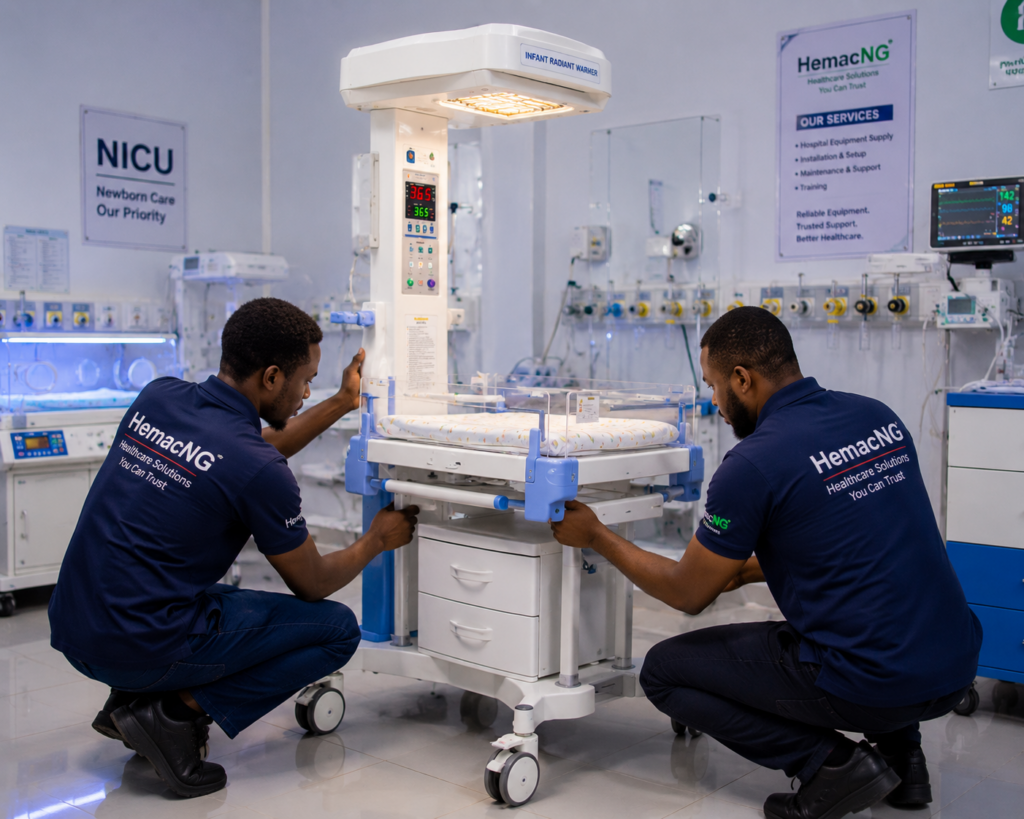
Installation, Training, and Maintenance: Keeping Your Warmer Safe and Reliable
Even the best infant radiant warmer in Nigeria cannot perform well if it is not installed correctly or if staff do not use it properly.
Installation
- Should be done or supervised by a trained technician
- Includes checking power connections, earthing, and stability
- Confirms temperature calibration and alarm function
Training
All staff who might use the warmer (midwives, doctors, nurses) should know:
- How to switch between manual and servo modes
- Proper placement of the skin probe
- How to set target temperatures
- What each alarm means and how to respond
- Basic cleaning and infection control procedures
Maintenance
- Regular cleaning of surfaces with approved disinfectants
- Checking probe cables and connectors for damage
- Periodic technical checks and calibration according to manufacturer guidelines
HemacNG can include basic user orientation during installation and advise on maintenance schedules. Over the lifetime of a device, that support matters as much as the purchase itself.
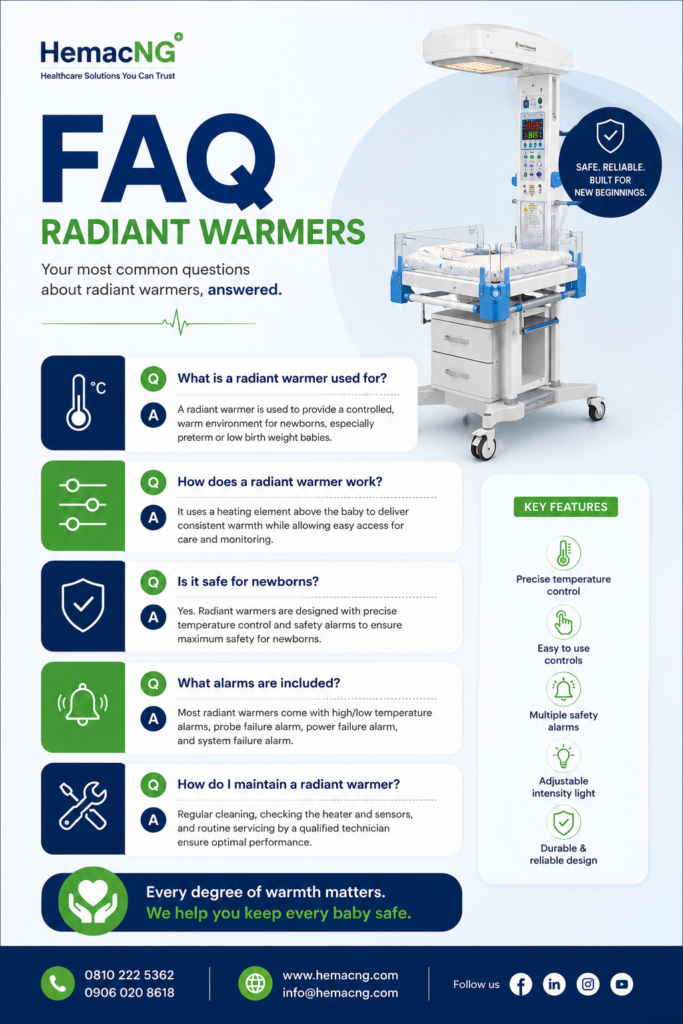
Frequently Asked Questions About Infant Radiant Warmers in Nigeria
What is the difference between an infant radiant warmer and an incubator?
A radiant warmer is an open unit with overhead heat, ideal for resuscitation and procedures where staff need full access. An incubator is a closed environment that controls temperature, humidity, and sometimes oxygen, used mainly for longer‑term care. Many NICUs use both, but an incubator is not a direct replacement for a radiant warmer.
How much does an infant radiant warmer cost in Nigeria?
As of 2026, a basic infant radiant warmer in Nigeria starts around ₦1.2 million, while advanced units with integrated resuscitation or phototherapy can exceed ₦8–9 million. Actual pricing depends on features, brand, and warranty terms.
Does every delivery room need a radiant warmer?
Ideally, yes. At minimum, high‑risk or high‑volume delivery suites and theatres should have direct access to a functioning warmer. Babies who are small, preterm, or distressed benefit enormously from immediate thermal support.
What power backup should I use with a radiant warmer in Nigeria?
Because of frequent power cuts, connecting warmers to an inverter or UPS linked to a generator is strongly recommended. Your supplier or hospital engineer can help size these correctly.
Can HemacNG install and service infant radiant warmers?
Yes. HemacNG coordinates delivery, installation, and basic user orientation for equipment they supply. They can also advise on service and maintenance options for the long term.
Where can I see available infant radiant warmers and get a quote?
You can visit HemacNG’s website to explore neonatal equipment and request a detailed quote for your facility.
Final Thoughts: One Decision That Echoes Through a Lifetime
In the first few minutes of life, a newborn cannot speak. Their tiny body tells you everything in other ways:
- Warm or cold
- Pink or blue
- Crying or silent
An infant radiant warmer cannot fix every problem, yet it gives that baby a fighting chance by doing one very simple, very powerful thing: it stops them from losing heat while skilled hands do the rest.
Choosing the best infant radiant warmer in Nigeria for your facility is not just an equipment purchase. It is a commitment to:
- Better outcomes for premature and fragile newborns
- Safer, calmer working conditions for your team
- A higher standard of care that families feel from the very first cry
If you are planning to upgrade or expand a maternity unit, theatre, or NICU, this is your opportunity to invest wisely.
- Browse infant radiant warmers and neonatal equipment on HemacNG
- Request a tailored quote for your hospital or clinic
- Speak with a HemacNG specialist about your delivery room or NICU setup
The baby who will lie under that light tomorrow does not know your budget meetings or procurement battles. They only know whether they feel cold or held in a safe, warm space while life begins.