

Uncategorized
Best Wheelchairs for Stroke Patients in Nigeria: Buying Guide
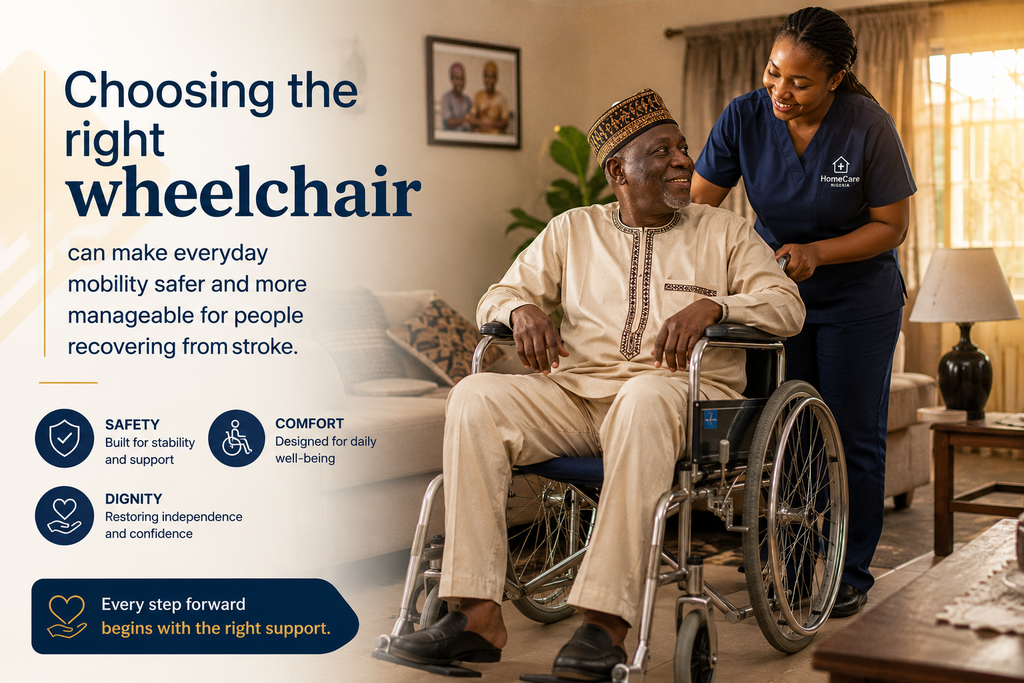
After a stroke, everyday activities can suddenly feel completely different. A short walk from the bedroom to the sitting room may become exhausting, and getting outside for a hospital appointment may require an entirely new plan. For families navigating this transition, finding the best wheelchairs for stroke patients is not simply about buying a mobility device. It is about finding equipment that supports comfort, safety, dignity and, where appropriate, greater independence.
Choosing correctly, however, can be confusing. Should you buy a standard manual wheelchair? Would a reclining model be more suitable? Is an electric wheelchair worth the extra investment? And how much should you budget?
These are important questions, particularly when the person using the wheelchair is a parent, spouse, relative or patient you care deeply about.
In this guide, we will walk through the most important wheelchair options for stroke survivors, the features worth considering, current examples and prices available from HemacNG, and what to check before placing an order. We will also explain why the best wheelchairs for stroke patients are not necessarily the most expensive ones.
Medical note: Wheelchair selection should be individualized. A physiotherapist, occupational therapist or other qualified rehabilitation professional can help assess mobility, posture, transfers and seating needs, especially for people with significant weakness or balance difficulties.
Why Choosing the Right Wheelchair Matters After a Stroke
A stroke can affect movement in many different ways.
One person may have weakness on one side of the body but still be able to walk short distances. Another may struggle with balance or fatigue and need a wheelchair for longer trips. Someone else may have significant mobility limitations and require a wheelchair throughout much of the day.
Therefore, there is no single wheelchair that is automatically right for everyone.
Clinical stroke guidance recommends appropriate mobility aids for people with limited walking ability and emphasizes individualized assessment. Positioning is also important because appropriate support can help reduce discomfort, shoulder problems, skin pressure and other complications associated with limited mobility.
That is why choosing among the best wheelchairs for stroke patients should begin with the individual’s needs rather than the product’s appearance or price tag.
For example, if one arm is significantly weaker following a stroke, proper arm support becomes particularly important. Stroke guidance specifically recommends supporting the affected arm, including through wheelchair armrests where appropriate.
In other words, a wheelchair should do more than move someone from one place to another. It should provide a stable and comfortable platform for mobility.
What Should You Look for in the Best Wheelchairs for Stroke Patients?
Before choosing a wheelchair, take a moment to consider how, where and by whom it will be used.
Here are some of the most important features to examine.
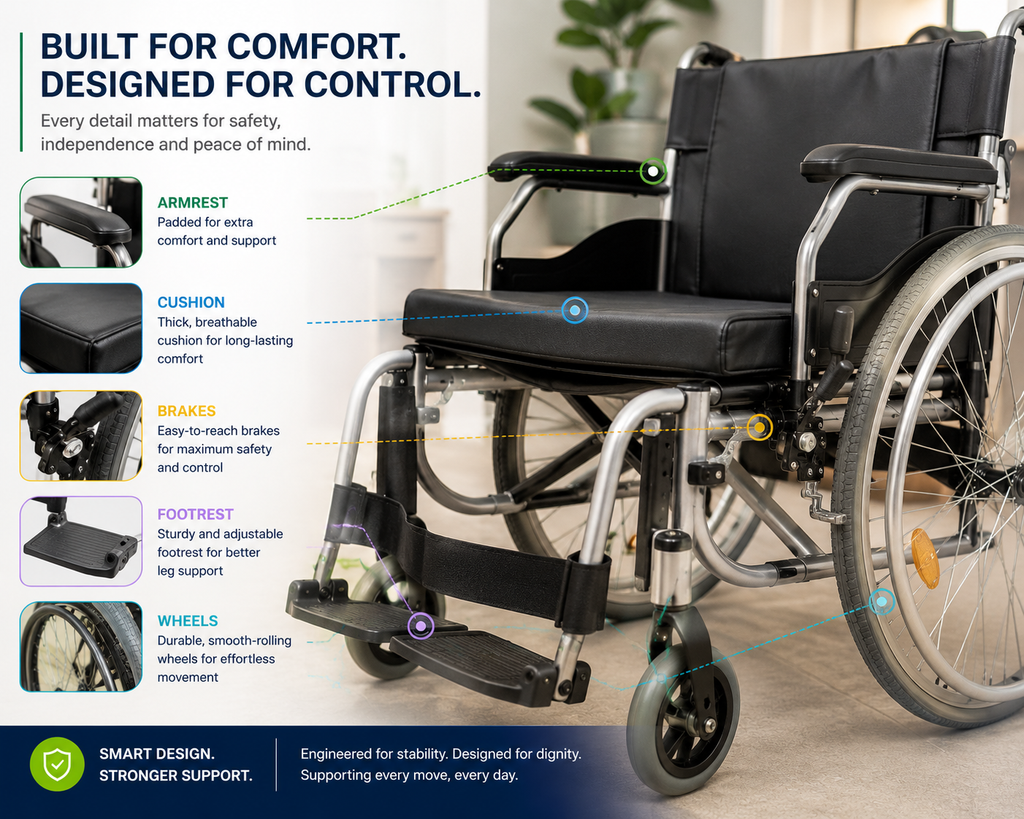
1. Comfortable and Supportive Seating
Comfort becomes increasingly important when a person spends extended periods in a wheelchair.
Look for:
- Appropriate seat width
- Adequate seat depth
- Supportive backrest
- Comfortable cushioning
- A stable seating surface
- Appropriate positioning support
A wheelchair that is too narrow may feel restrictive, while one that is excessively wide may provide inadequate lateral support.
Additionally, prolonged sitting can increase the importance of pressure management. Stroke rehabilitation guidance recommends attention to skin protection and appropriate seating or wheelchair cushions for people at risk of skin breakdown.
So, rather than asking only, “How much is the wheelchair?”, ask, “Will this wheelchair fit the person properly?”
2. Strong and Practical Arm Support
One of the most overlooked considerations when purchasing a wheelchair for a stroke survivor is arm positioning.
Weakness on one side can make it difficult for a person to support the affected arm independently. Allowing the arm to hang unsupported can contribute to discomfort and shoulder problems.
For this reason, appropriate armrests, lap trays or other positioning supports may be useful depending on the person’s needs.
A qualified rehabilitation professional can advise on the appropriate positioning system.
3. Adjustable Footrests and Leg Support
The feet and legs should have appropriate support when the person is seated.
Look for wheelchairs with:
- Detachable footrests
- Adjustable leg support where appropriate
- Stable footplates
- Easy-to-manage footrests for transfers
This is particularly useful when a caregiver frequently needs to help the patient move between a bed, chair and wheelchair.
4. Reliable Brakes and Safety Features
A wheelchair should remain stable when it is parked.
Check for:
- Locking brakes
- Stable wheels
- Strong frame construction
- Secure footrests
- Appropriate anti-tip features where applicable
Caregivers should also understand how the wheelchair’s brakes and transfer mechanisms work before using the chair with a patient.
5. Reclining or Positioning Features
Some stroke survivors have difficulty remaining upright for long periods.
A reclining wheelchair can provide additional positioning flexibility. However, reclining capability is not automatically necessary for every stroke patient.
The important question is
Does the individual actually need this feature?
Professional assessment is particularly useful when the person has significant postural limitations.
Research and clinical guidance emphasize the importance of appropriate wheelchair positioning for people with post-stroke impairments.
6. Ease of Transportation
If the wheelchair will frequently be transported in a car, portability matters.
A foldable wheelchair may be preferable for families who regularly travel to:
- Hospitals
- Physiotherapy appointments
- Religious gatherings
- Family events
- Shopping centers
- Community activities
A wheelchair that folds easily can save considerable effort for caregivers.
7. Appropriate Weight Capacity
Never overlook the manufacturer’s maximum weight capacity.
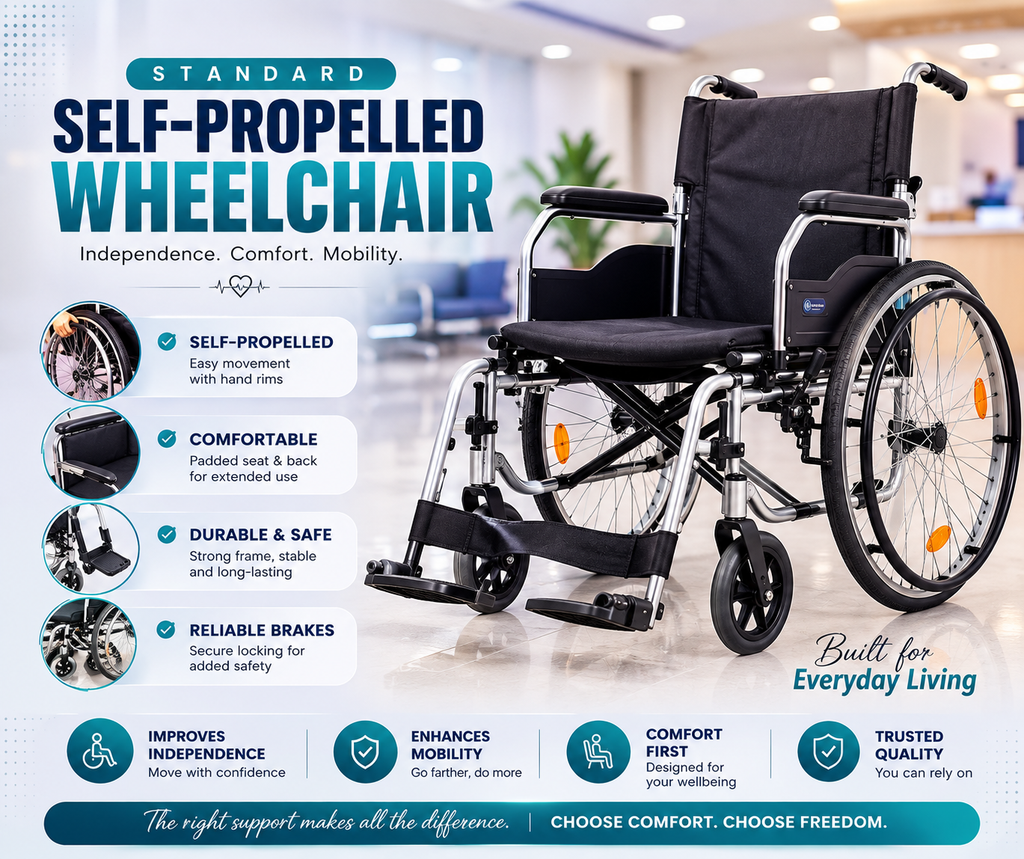
For example, HemacNG’s standard wheelchair currently lists a maximum user weight of 130 kg. It also features a powder-coated steel frame, 24-inch rear wheels, push-to-lock brakes, and a foldable design.
Always compare the patient’s weight with the manufacturer’s stated capacity before purchasing.
Types of Wheelchairs for Stroke Patients
Now that you know what to look for, let’s examine the main types.
Standard Manual Wheelchairs
A standard manual wheelchair can be a practical choice for a stroke survivor who has limited walking ability and has a caregiver available to assist with mobility.
For example, HemacNG’s standard wheelchair is listed at ₦145,000 at the time of writing and has a 130 kg maximum load capacity. Its folding design can also make transportation easier. Shop the Standard Wheelchair on HemacNG.
This type of wheelchair can work particularly well for families looking for a straightforward mobility solution without the additional complexity of a powered system.
Lightweight and Foldable Wheelchairs
Portability can make a major difference.
Imagine needing to take a loved one to a physiotherapy appointment. If the wheelchair is difficult to fold or too bulky for the vehicle, what should be a routine trip can quickly become stressful.
A foldable model may simplify transportation and storage.
When comparing options, look beyond the word “lightweight.” Check the actual product weight, frame construction, dimensions, and weight capacity.
Reclining Wheelchairs
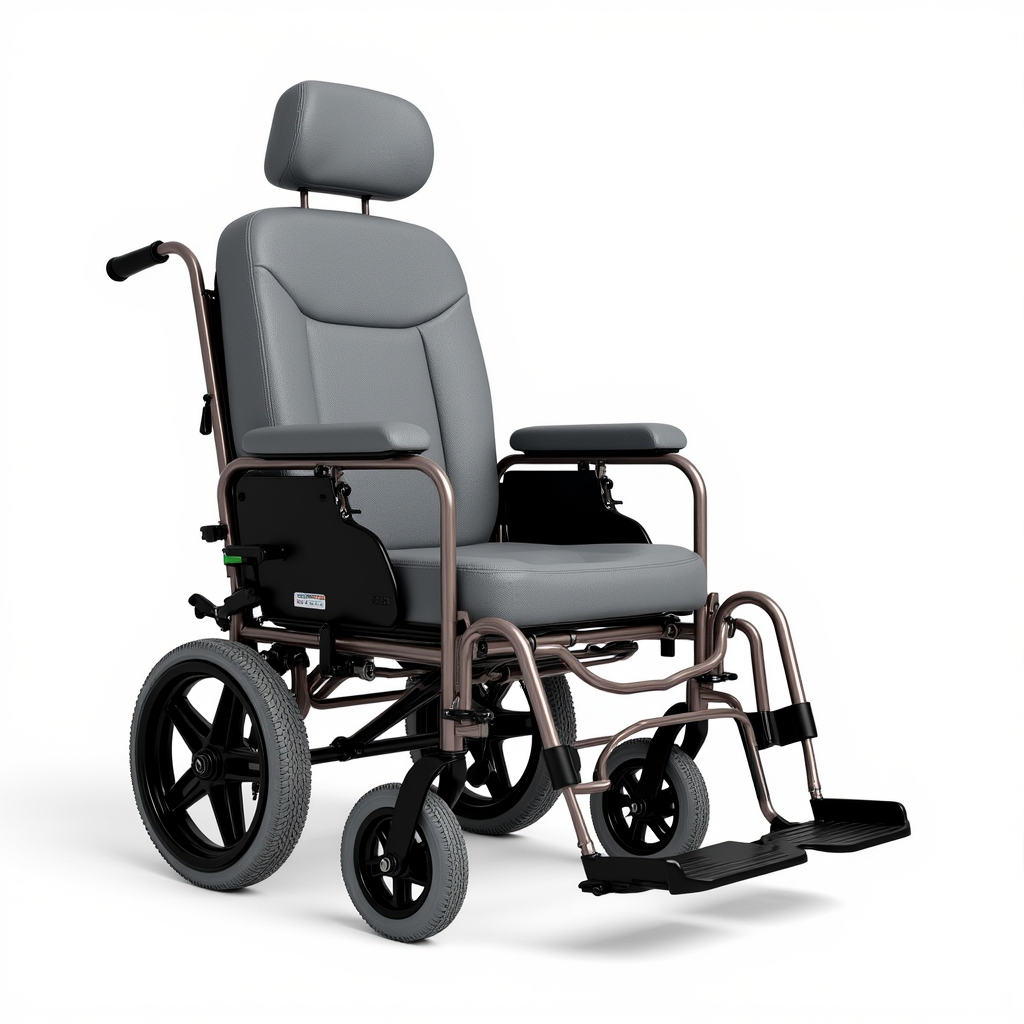
Reclining wheelchairs provide additional backrest adjustment.
They can be considered when a user needs more flexibility in positioning or has difficulty remaining upright for prolonged periods.
HemacNG currently lists an electric reclining wheelchair with an adjustable backrest, detachable high backrest, flip-up armrests, and reclining capability. The listed model has a maximum load of 130 kg and a stated driving range of up to 15 km. Explore the Electric Reclining Wheelchair on HemacNG
Important: A reclining function should not be treated as a substitute for professional seating assessment.
Electric Wheelchairs
For some people, manually propelling a wheelchair is simply too difficult.
An electric wheelchair may provide an alternative for appropriate users who cannot efficiently self-propel a manual model.
HemacNG’s listed electric wheelchair has a 160 kg maximum load, a maximum speed of 6 km/h, a stated driving distance of approximately 15–20 km and a 24V 12Ah battery. View the Electric Wheelchair on HemacNG
However, powered mobility requires more than purchasing the chair. The user must be able to operate the controls safely, or appropriate caregiver support must be available.
Commode Wheelchairs
For a stroke survivor with significant mobility limitations, reaching the bathroom may be difficult or unsafe.
A commode wheelchair can combine mobility and toileting functionality.
HemacNG’s commode wheelchair is listed at ₦165,000 and includes a removable commode pan, detachable footrests, padded armrests and rear-wheel brakes. The listed weight capacity is 100 kg. Shop the Commode Wheelchair on HemacNG
This can be especially useful for home care situations where moving a patient repeatedly between a bedroom and bathroom is challenging.
Manual vs Electric Wheelchair for Stroke Patients
One of the most common questions families ask is whether they should purchase a manual or electric wheelchair.
Here’s a simple comparison:
| Feature | Manual Wheelchair | Electric Wheelchair |
|---|---|---|
| Power source | User/caregiver | Battery |
| Typical cost | Lower | Higher |
| Portability | Generally easier | Usually heavier |
| Caregiver assistance | Often required | May be reduced |
| Maintenance | Relatively simple | More technical |
| Independence | Depends on user’s strength | Can provide powered mobility |
| Charging | Not required | Required |
| Best for | Assisted mobility | Appropriate users needing powered mobility |
The right choice depends on the individual.
For example, someone with reasonable upper-body strength and a supportive caregiver may find a manual wheelchair perfectly adequate. Conversely, someone who cannot propel a manual chair may benefit from powered mobility.
The goal is not to buy the most sophisticated product. The goal is to buy the most appropriate product.
How Much Does a Wheelchair for a Stroke Patient Cost in Nigeria?
Wheelchair prices in Nigeria vary significantly according to the type, design, features, materials, weight capacity and whether the chair is manual or powered.
Current HemacNG listings provide a useful illustration:
- Standard wheelchair: ₦145,000
- Commode wheelchair: ₦165,000
- Executive/Reclining Commode Wheelchair: ₦300,000
- Cerebral Palsy Wheelchair: ₦450,000
- Electric wheelchair: listings include ₦650,000 on sale and another model at ₦800,000
- Electric reclining wheelchair: ₦1,500,000
These prices were displayed on HemacNG’s website when this article was researched and may change as stock, promotions and market conditions change.
See Current Wheelchair Prices on HemacNG
This is why it is better to check the current product listing before budgeting.
How to Choose the Right Wheelchair for a Stroke Patient
Buying the best wheelchairs for stroke patients becomes much easier when you break the decision into simple questions.
Step 1: How Mobile Is the Patient?
Can the person:
- Walk independently?
- Walk with a walking aid?
- Stand with assistance?
- Transfer from a bed to a chair?
- Propel a manual wheelchair?
The answers will help determine whether a manual or powered model is more appropriate.
Step 2: Is One Side of the Body Weaker?
Stroke frequently affects movement on one side.
If the affected arm is weak, think carefully about arm support and positioning.
Clinical guidance recommends supporting the affected arm, including through appropriate wheelchair armrests, to help reduce shoulder problems.
Step 3: Can the Person Maintain Their Sitting Position?
If the person struggles to sit upright or maintain their balance, additional seating or positioning features may be required.
This is an excellent situation in which to involve a physiotherapist or occupational therapist.
NICE recommends assessing post-stroke patients’ positioning, movement, strength, balance, and other functional needs.
Step 4: Who Will Operate the Wheelchair?
This question is particularly important for electric models.
If the patient cannot safely operate a joystick or other control system, they may need caregiver assistance.
Step 5: Where Will the Wheelchair Be Used?
Consider the actual environment.
Will the wheelchair be used?
- Mostly indoors?
- Outdoors?
- On uneven ground?
- In hospital corridors?
- In a small apartment?
- During frequent car trips?
A wheelchair that works beautifully in a spacious hospital may be inconvenient inside a narrow home.
Step 6: Measure Before You Buy
Do not guess the size.
Check the wheelchair’s:
- Seat width
- Seat depth
- Seat height
- Overall width
- Backrest height
- Weight capacity
For example, HemacNG’s electric reclining wheelchair has a listed seat width of 46 cm, a seat depth of 45 cm, and a maximum load of 130 kg.
Comparing these measurements with the user’s requirements can prevent an expensive mistake.
Common Mistakes to Avoid When Buying a Wheelchair
Choosing Only by Price
A low price may look attractive, but it should never be your only criterion.
Think about durability, comfort, maintenance, and suitability.
Buying the Wrong Size
An unsuitable wheelchair can create discomfort and positioning problems.
Always check the specifications before ordering.
Ignoring the Home Environment
Measure doorways and corridors if the wheelchair will primarily be used at home.
This simple step can prevent an unpleasant surprise after delivery.
Choosing an Electric Wheelchair Automatically
Powered mobility can be valuable, but it isn’t necessary for every stroke survivor.
The person’s abilities, environment, support system, and rehabilitation goals should guide the decision.
Forgetting About Arm Support
This is especially important when one arm has been affected.
Stroke rehabilitation resources emphasize careful positioning and support of the affected arm during wheelchair use.
Where to Buy the Best Wheelchairs for Stroke Patients in Nigeria
After you’ve considered the patient’s needs, the next question is straightforward:
Where can you buy a reliable wheelchair?
HemacNG offers a range of wheelchair and mobility products through its online medical equipment store. Its current wheelchair collection includes standard manual, commode, electric, reclining and specialized mobility options. Shop All Wheelchairs on HemacNG
The wider HemacNG mobility category also includes walking sticks, walkers, patient lifts and other mobility-related equipment. Explore Mobility Aids on HemacNG
This makes it easier for families and healthcare facilities to consider mobility as part of a broader care plan rather than purchasing equipment in isolation.
Why Consider HemacNG for Stroke Mobility Equipment?
Choosing a supplier is just as important as choosing the wheelchair itself.
HemacNG describes itself as an online medical store supplying hospital, laboratory, and physiotherapy equipment in Nigeria. The company also states that it provides supply and installation support through partnerships with trained biomedical engineers.
Its website also advertises after-sales setup support and a 100% money-back guarantee under its stated returns policy.
For buyers who need clarification before ordering, HemacNG’s contact page provides its Lagos location, telephone number, and email contacts. Contact HemacNG for wheelchair inquiries.
Most importantly, don’t hesitate to ask questions before buying. Provide the user’s approximate weight, mobility level, intended environment, and the features you need. That information can help narrow down the available options.
Frequently Asked Questions About Wheelchairs for Stroke Patients
What is the best wheelchair for a stroke patient?
No single wheelchair is best for every stroke survivor. The appropriate choice depends on mobility, strength, balance, posture, body measurements, caregiver support, and intended use.
Can a stroke patient use a normal wheelchair?
Yes. A standard manual wheelchair may be appropriate for some stroke survivors with limited walking ability, particularly when caregiver assistance is available. However, people with more complex positioning needs may require additional features.
Is an electric wheelchair good for stroke patients?
An electric wheelchair can be useful for an appropriate user who cannot effectively propel a manual chair. However, the person should be able to operate the controls safely or have suitable assistance.
How much is a wheelchair for a stroke patient in Nigeria?
Prices vary considerably. Current HemacNG listings range from approximately ₦145,000 for a standard wheelchair to ₦1.5 million for an electric reclining wheelchair, depending on the model and specifications. Always check the current listing because prices can change.
Should I buy a reclining wheelchair for a stroke patient?
Not necessarily. A reclining wheelchair may be useful for some people who need additional positioning flexibility, but the requirement should be based on the individual’s needs.
Where can I buy a wheelchair for a stroke patient in Nigeria?
HemacNG offers a range of manual, electric, reclining, and commode wheelchairs online. View HemacNG’s Wheelchair Collection
Final Thoughts: The Right Wheelchair Is About More Than Mobility
A wheelchair can look like a simple piece of equipment.
For a family dealing with stroke recovery, however, it can represent something much bigger.
It can mean getting outside after weeks indoors.
It can mean attending physiotherapy without struggling through every step.
That is why finding the best wheelchairs for stroke patients should never be reduced to a quick price comparison.
Start with the person.
Consider their mobility. Think about their posture. Check their measurements. Look at the home environment. Consider caregiver support. Then choose the wheelchair that makes the most sense for their actual circumstances.
And when you’re ready to compare options, HemacNG provides a growing range of mobility products for families, caregivers, and healthcare facilities.
Your loved one’s mobility deserves thoughtful equipment, not guesswork. Explore Wheelchairs on HemacNG Today