

Uncategorized
How to Take Care of Hospital Equipment: HemacNG Guide
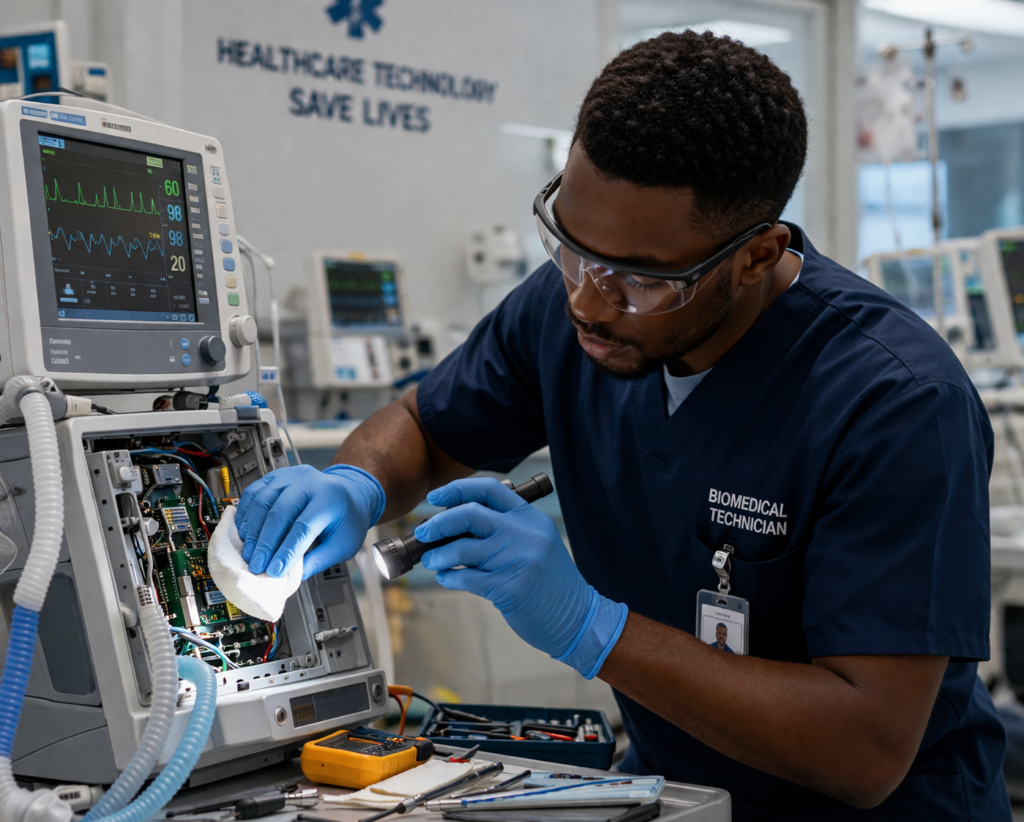
A patient is on the table. The team is ready. Someone switches on the monitor… and nothing happens. “Was it doing this yesterday?” “Yes. We thought it would be fine.” In that moment, the question is no longer technical. It’s deeply human: Is this patient safe? Many of these crises could have been prevented if the whole team understood how to take care of hospital equipment, not just engineers, but nurses, doctors, lab staff, and managers, too.
Let me tell you a story that changed how I think about equipment care forever. It’s 3 AM in a neonatal intensive care unit. A premature baby, barely two pounds, is fighting for her life inside an incubator. The nurse notices something alarming. The temperature reading seems off. Way off.
She checks the settings. Everything looks correct on the display. But the baby’s skin feels too warm. Something isn’t right. It turns out the temperature sensor hadn’t been calibrated in over eight months. The filters hadn’t been cleaned in weeks. And the humidity control wasn’t working properly because nobody noticed the slow buildup of mineral deposits.
According to the World Health Organization, between 50 and 80% of medical equipment in developing countries is either broken down or not functioning at full capacity. That’s not a statistic. That’s a crisis. And much of it traces back to one simple failure: not knowing how to take care of hospital equipment properly.
At HemacNG, we’ve spent years supplying medical equipment to hospitals across Nigeria and worldwide. We’ve seen firsthand what happens when equipment is cared for beautifully and what happens when it’s neglected. This guide captures everything we’ve learned. So let’s make sure no patient in your hospital ever suffers because of neglected equipment.
Understanding the Two Levels of Equipment Care
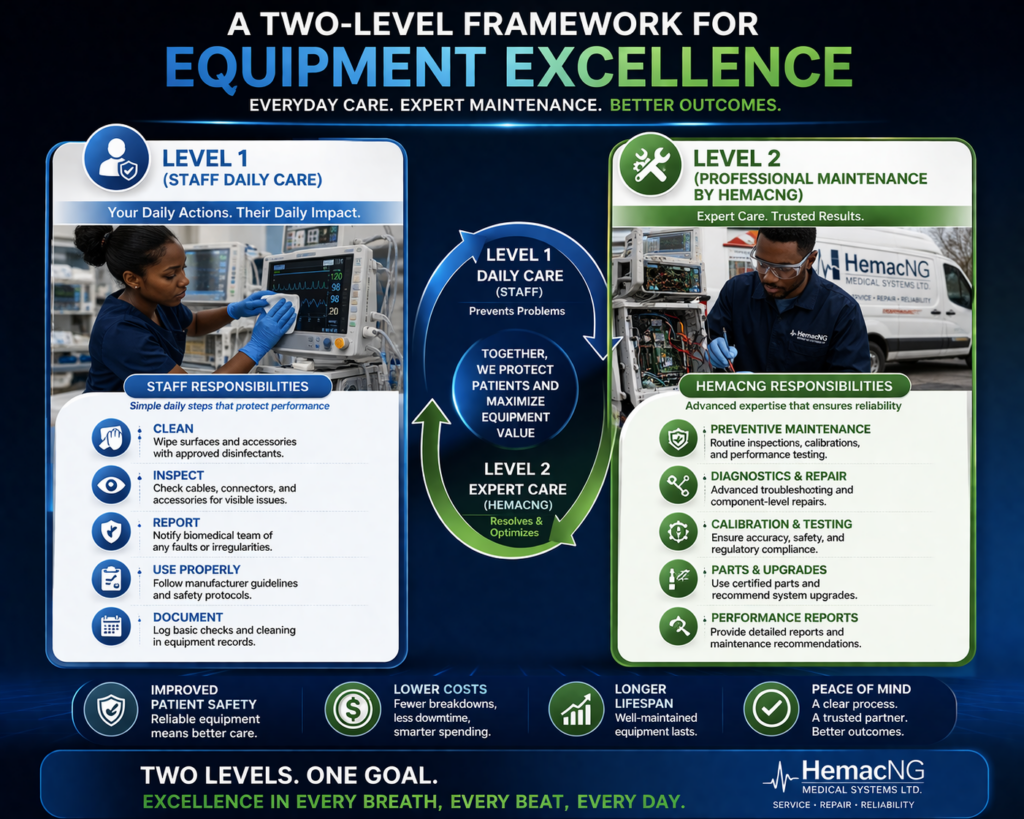
Here’s a framework that makes everything clearer and more manageable. Taking care of hospital equipment happens at two interconnected levels. Both are essential. Skip either one, and your equipment and your patients will suffer.
Level 1: Daily User Care is what your staff does every day. Cleaning, handling, inspecting, reporting problems, and storing equipment properly. Every nurse, doctor, technician, and porter plays a role.
Level 2: Professional maintenance is what trained biomedical engineers do. Preventive maintenance, calibration, repairs, spare parts replacement, and software updates. This requires expertise and a reliable service partner.
Think of it like dental health. You brush and floss daily (Level 1). But you still visit the dentist for professional cleanings and check-ups (Level 2). Together, they keep your teeth healthy for life. Skip either one, and problems develop fast.
For more context on professional maintenance, read: What is Medical Equipment After-Service? And for the complete management picture: What Goes Into Hospital Medical Equipment Management? Let’s explore both levels in detail.
Level 1: Daily Equipment Care Practices for All Staff
These are the habits your team should practice every single day. They’re simple. They’re quick. And they’re incredibly powerful.
1. Clean Equipment Properly After Every Use
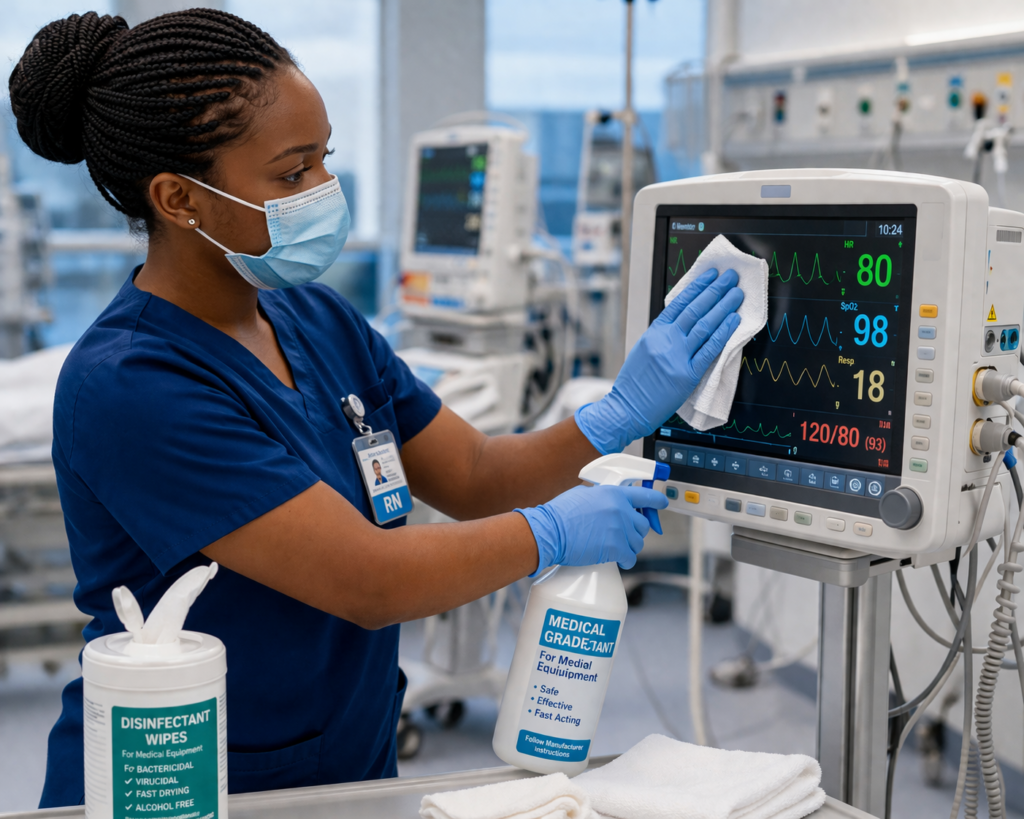
This is the foundation. The absolute bedrock of equipment care. Every external surface should be cleaned after every patient contact. Not just when it looks dirty. Every single time. This protects against hospital-acquired infections and prevents the buildup of grime that degrades equipment over time. Here are the golden rules:
Always use manufacturer-recommended cleaning solutions. Household cleaners, bleach, window cleaner, and all-purpose sprays can damage screens, corrode metals, and degrade plastics. Medical-grade cleaning solutions are formulated specifically for medical equipment.
Use soft, lint-free cloths. Never use abrasive scrubbers, steel wool, or rough paper towels on equipment surfaces. Especially screens and sensors.
Pay special attention to high-touch areas, touchscreens, buttons, knobs, patient-contact surfaces, and cable connectors. These accumulate bacteria fastest and affect functionality first.
Never spray liquid directly onto electronic equipment. Instead, dampen a cloth and wipe. Liquid entering vents, ports, or gaps causes electrical damage.
Dry equipment thoroughly after cleaning. Moisture left on surfaces promotes corrosion and bacterial growth. For infection control standards, reference the WHO Infection Prevention and Control Guidelines, which provide excellent frameworks for equipment disinfection protocols.
2. Handle Equipment with Respect and Care
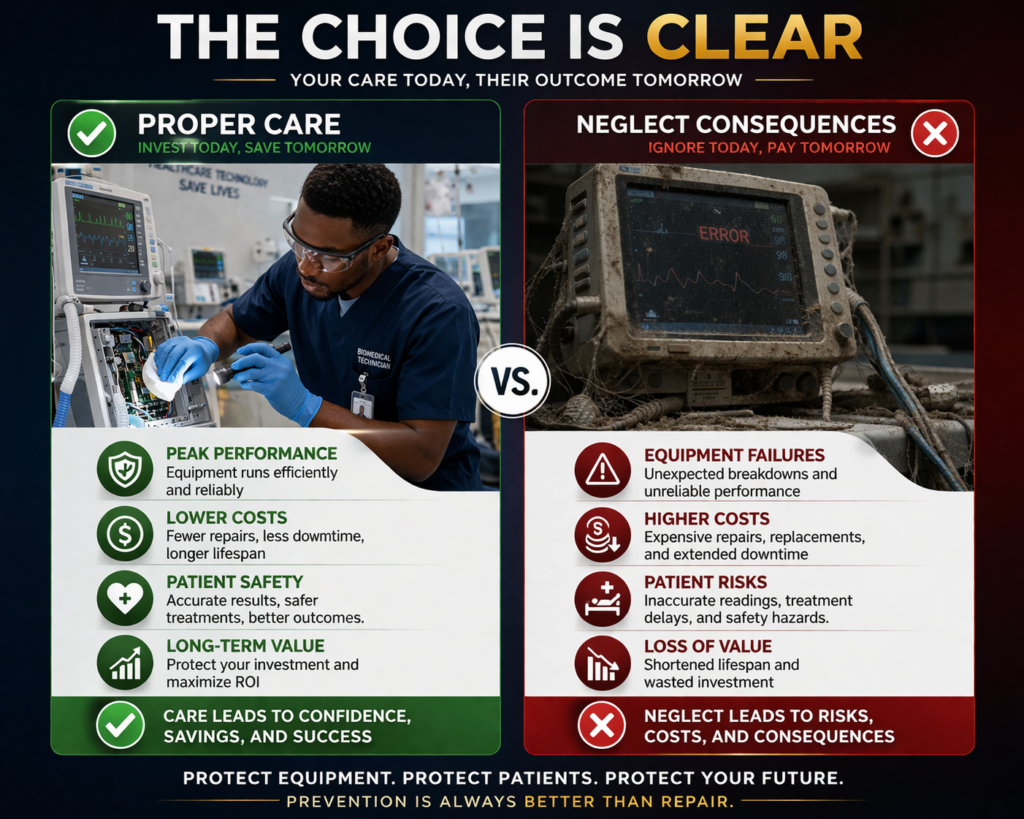
Medical equipment contains precision-engineered components, sensitive electronics, calibrated sensors and delicate mechanisms. Rough handling damages these components in ways that aren’t always immediately visible but show up later as inaccurate readings, intermittent failures, and premature breakdowns.
Move equipment carefully. Push gently. Avoid bumping into walls, doorframes, or other equipment. Lock wheels when stationary. Use two-person lifts for heavy devices.
Handle cables gently. This one is huge. Cable damage is one of the most common and most frustrating equipment problems. Never yank cables from outlets. Don’t bend them sharply. Don’t roll equipment wheels over them. Coil them loosely when storing.
Keep liquids away from electronics. One coffee spill can destroy a ₦5 million patient monitor. It happens more often than you’d think.
Never stack heavy items on sensitive devices. Never use equipment as a shelf, a table, or a leaning post. And never, ever use equipment for purposes it wasn’t designed for.
These might seem like small things. But accumulated rough handling is the silent killer of medical equipment. Train every staff member, not just clinical staff, on proper handling. HemacNG provides comprehensive handling training as part of our service commitment.
3. Follow Manufacturer Operating Guidelines
I know reading user manuals isn’t anyone’s idea of fun. But those manuals exist for critical reasons; they protect your patients AND your equipment.
Follow proper startup and shutdown sequences. Many equipment problems stem from incorrect power cycling. Modern medical devices have specific boot-up processes that initialize sensors and run self-checks. Skipping these creates issues.
Use correct settings for each clinical application. Operating equipment outside its intended parameters causes premature wear, inaccurate results, and potential patient harm.
Don’t bypass safety features. Alarms, interlocks, and safety locks exist for vital reasons. Overriding them “to save time” creates risks that far outweigh any time saved.
Address alarm fatigue properly. Yes, frequent alarms can be exhausting. But the solution is adjusting alarm parameters appropriately, NOT silencing them permanently. Report nuisance alarms to your biomedical team for proper adjustment.
Keep simplified quick-reference cards posted next to each device. These help staff follow correct procedures even during high-pressure situations.
4. Perform Daily Inspections: The 5-Minute Habit That Saves Millions
This takes just 2-5 minutes per device. And it’s worth every second. Every day, before using the equipment, check:
- Physical condition — Any cracks, dents, loose parts, frayed cables?
- Power status — Does it turn on normally without error messages?
- Display — Is the screen clear and readable?
- Battery — Is the charge adequate on portable devices?
- Alarms — Do critical alarms respond when tested?
- Cleanliness — Is it clean and ready for patient use?
- Accessories — Are all necessary accessories present?
- Consumables — Paper, reagents, filters adequate?
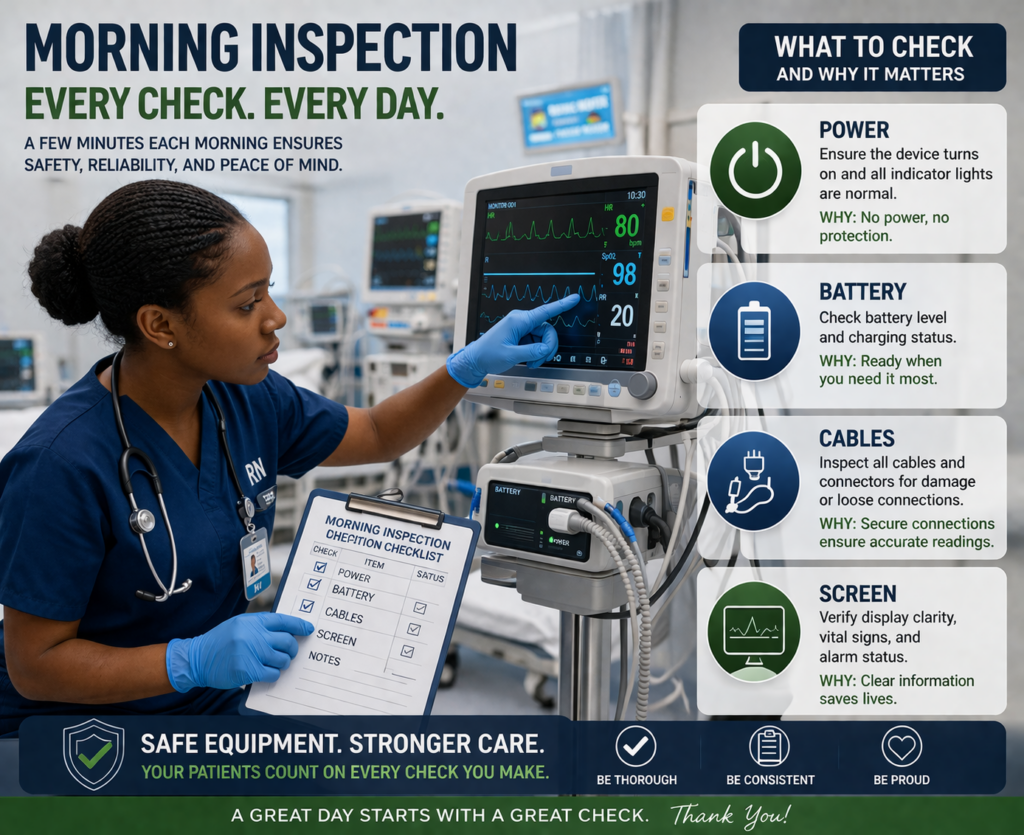
Assign specific staff members to daily inspections each shift. Make it part of your shift handover process. Use printed checklists. And keep records, because documented inspections catch patterns that prevent failures.
5. Report Problems Immediately: Never Ignore, Never DIY
This is absolutely critical. And it has two equally important parts.
Never ignore warning signs. A monitor that flickers occasionally. A ventilator is making an unusual sound. A lab analyzer showing intermittent errors. These aren’t minor inconveniences; they’re early warnings of developing failures. Report them immediately. Every time.
Never attempt repairs yourself unless you’re a qualified biomedical engineer. Well-meaning but untrained repair attempts almost always cause more damage, void warranties, and create safety hazards. Report the issue. Tag the equipment. Step back. Let professionals handle it.
Build a no-blame reporting culture in your hospital. Staff should feel completely safe reporting equipment problems without fear of punishment. One small report today could prevent a catastrophic failure tomorrow.
6. Store Equipment Properly When Not in Use
Where equipment rests matters enormously.
Clean before storing; never put away dirty or contaminated equipment. Designate specific storage locations for every device. Maintain proper environmental conditions: temperature-controlled, dry, and dust-free.
Use dust covers on sensitive devices. Manage batteries properly during storage; charge according to manufacturer guidelines. Coil cables loosely; never wrap them tightly around equipment.
Organize storage areas so devices are easy to retrieve without bumping or damaging neighbouring equipment. Emergency equipment must be immediately accessible, labelled, charged, and ready.
Level 2: Professional Maintenance That Keeps Equipment Performing Perfectly
Everything we’ve covered so far is what your staff does daily. It’s essential and foundational. However, daily user care alone isn’t sufficient.
Just like your car needs regular professional servicing, not just daily driving care, your equipment needs expert maintenance from qualified biomedical engineers.
7. Implement a Structured Preventive Maintenance Program
If I could give you just ONE piece of advice about how to take care of hospital equipment, it would be this: invest in preventive maintenance. Nothing else comes close in terms of impact.
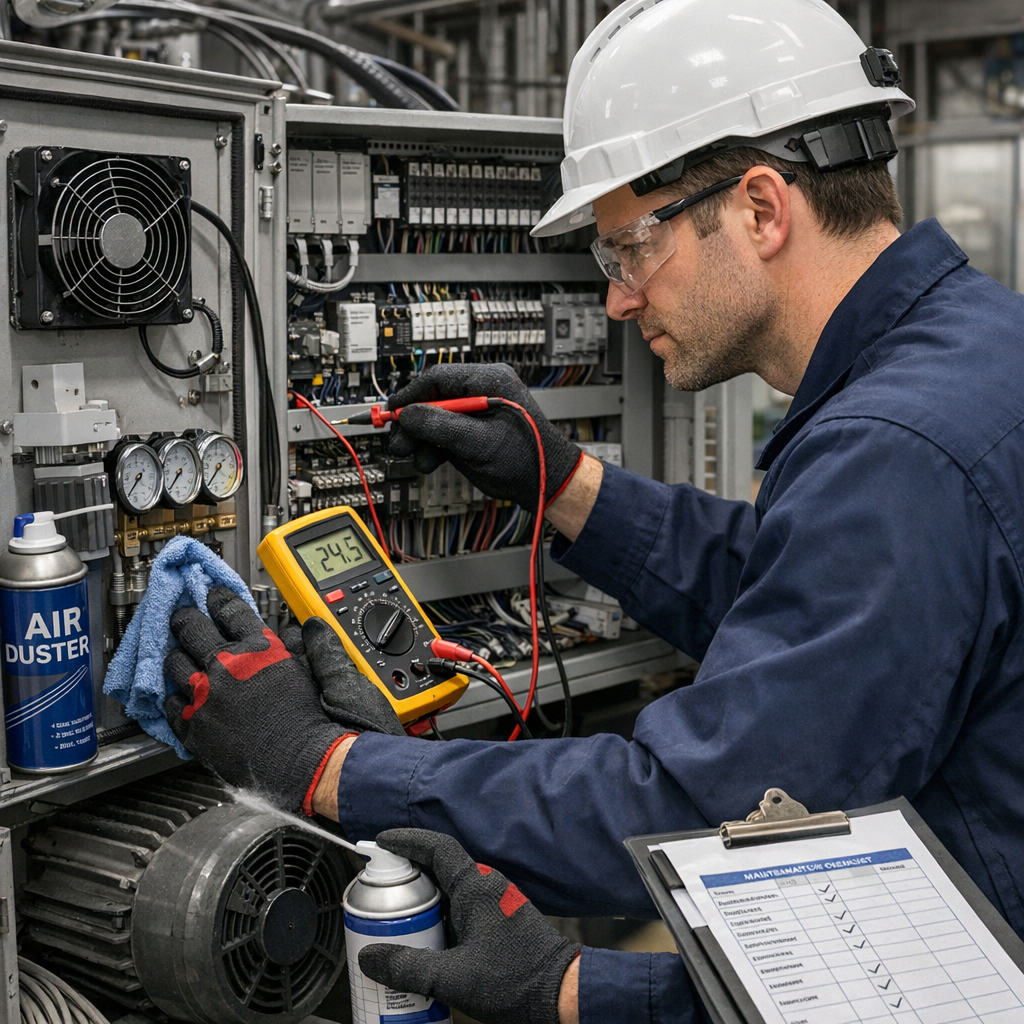
Preventive maintenance means servicing equipment on a scheduled basis, before anything goes wrong. It includes professional inspections, internal cleaning, lubrication, worn part replacement, performance testing, safety checks, and software updates. Here’s a general frequency guide:
| Equipment Type | Recommended Frequency |
|---|---|
| Ventilators & Defibrillators | Monthly — Quarterly |
| Patient Monitors | Quarterly — Biannually |
| Anesthesia Machines | Quarterly |
| Infusion Pumps | Quarterly — Biannually |
| Laboratory Analyzers | Monthly — Quarterly |
| Imaging Equipment (X-ray, Ultrasound) | Quarterly — Biannually |
| Autoclaves/ Sterilizers | Monthly — Quarterly |
| Incubators | Monthly — Quarterly |
| Hospital Beds | Biannually — Annually |
| Oxygen Concentrators | Quarterly |
The benefits are staggering. Preventive maintenance reduces unexpected breakdowns by up to 70% and extends equipment lifespan by 30-50%. Moreover, it costs significantly less than emergency repairs, typically 3-5 times less. HemacNG offers customized preventive maintenance programs tailored to your hospital’s specific equipment inventory. Our certified engineers follow manufacturer protocols to keep every device performing at its peak.
8. Schedule Regular Calibration
Calibration ensures your equipment gives accurate, trustworthy results. Without it, readings drift, sometimes subtly, sometimes dangerously.
Imagine a blood pressure monitor reading 120/80 when the actual pressure is 160/100. Or a lab analyzer reporting normal blood sugar when a patient is actually diabetic. Or a ventilator delivering the wrong tidal volume, causing lung damage.
These scenarios aren’t hypothetical. They happen in hospitals where calibration is neglected.
Equipment requiring regular calibration includes patient monitors, ventilators, infusion pumps, laboratory analyzers, blood pressure monitors, weighing scales, and imaging equipment. HemacNG’s calibration services ensure every measurement your equipment delivers is accurate and reliable, because in healthcare, wrong numbers lead to wrong decisions.
9. Use ONLY Genuine Spare Parts
This is a hill worth defending to the end. Never use counterfeit or incompatible spare parts in medical equipment.
Genuine parts are manufactured to exact OEM specifications. They’re guaranteed to be compatible. They maintain equipment performance. They preserve your warranty. And they ensure patient safety.
Counterfeit parts? They cause inaccurate performance, accelerate wear on other components, create safety hazards, and void your warranty completely.
The price difference between genuine and counterfeit parts is small compared to the cost of equipment damage, patient harm, and total warranty loss.
HemacNG supplies genuine, OEM-approved spare parts for all major medical equipment brands. No counterfeits. No compromises. Browse our product range.
10. Keep Comprehensive Maintenance Records
Here’s the golden rule of equipment management: if it’s not documented, it didn’t happen.
Document every maintenance activity, preventive and corrective. Record calibration results. Log parts replaced and costs incurred. Track downtime. Note issues identified and resolved. Why? Because documentation supports regulatory compliance. It reveals patterns in equipment behaviour. And it protects you legally.
11. Train Your Team Continuously
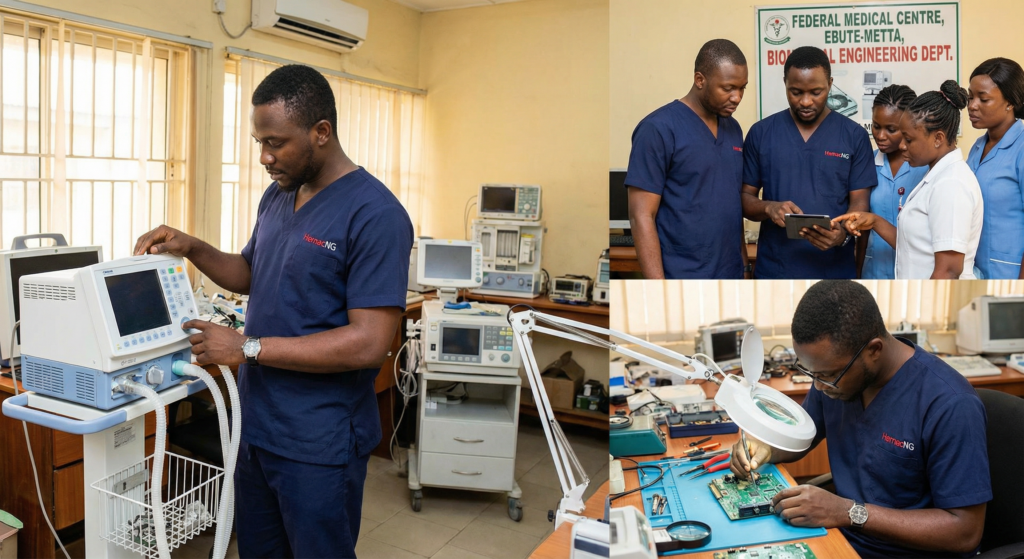
Training isn’t a one-time orientation. It’s an ongoing commitment that pays enormous dividends. Every new piece of equipment needs operational training before anyone uses it. Every new staff member needs equipment orientation. And every existing team member needs annual refresher courses.
Training should cover proper operation, daily care responsibilities, safety protocols, basic troubleshooting, and when and how to report problems. HemacNG provides comprehensive equipment training with every equipment purchase, plus ongoing refresher programs to keep your team confident and competent.
Equipment-Specific Care Quick Reference
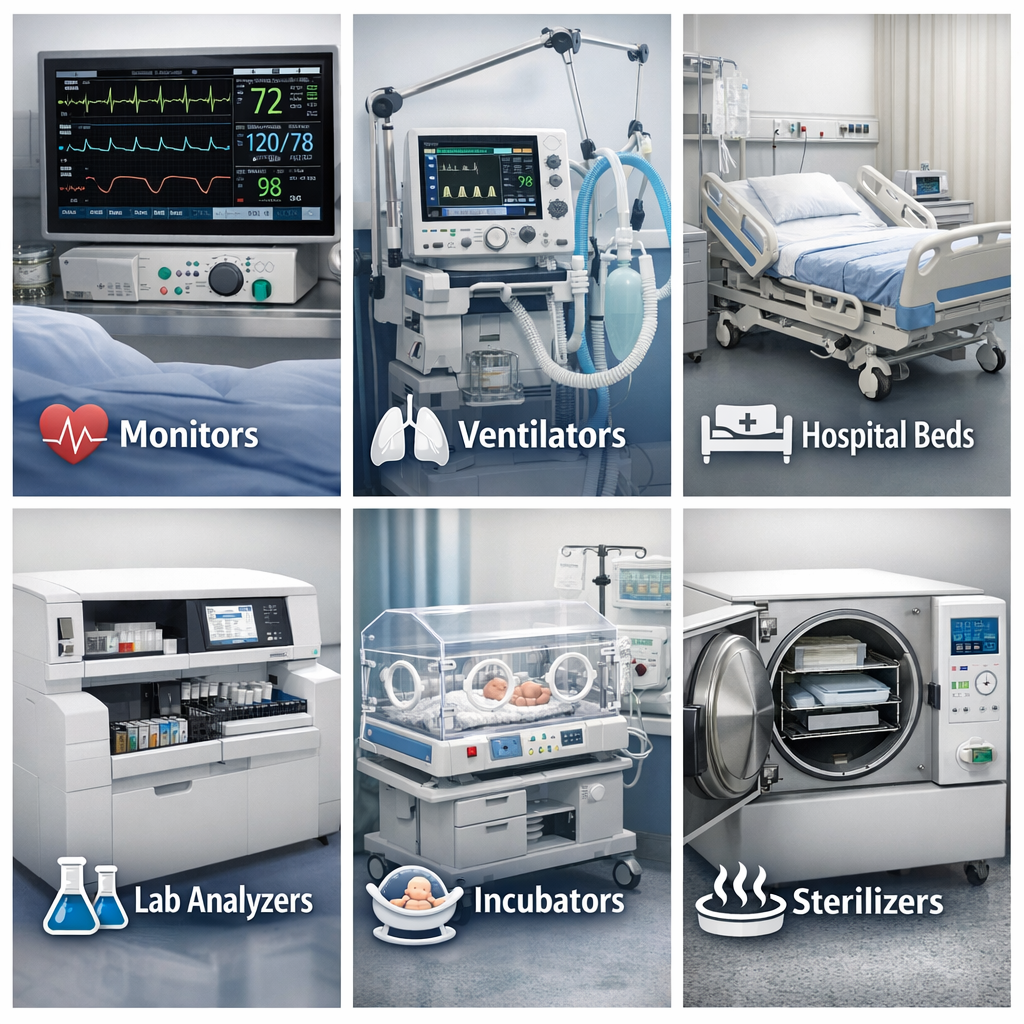
Different equipment demands different care. Here’s a quick reference guide you can share with each department:
Patient Monitors — Clean screens daily. Check lead wires weekly. Professional calibration quarterly. Browse monitors
Ventilators — Check circuits and filters daily. Clean exterior weekly. Professional maintenance quarterly. Browse ventilators
Surgical Instruments — Clean immediately after every use. Sterilize per protocol. Professional maintenance as needed. Browse instruments
Laboratory Analysers — Run daily quality controls. Clean weekly. Professional calibration is monthly to quarterly.
Hospital Beds — Check controls daily. Clean mechanisms weekly. Professional servicing biannually. Browse beds
Defibrillators — Check battery daily. Self-test weekly. Professional testing quarterly. Browse defibrillators
Autoclaves — Check water and gaskets daily. Clean the chamber weekly. Professional maintenance quarterly. Browse sterilizers
Incubators — Check temperature daily. Inspect humidity weekly. Professional calibration quarterly. Browse incubators
Infusion Pumps — Clean daily. Test alarms weekly. Professional calibration quarterly. Browse pumps
Imaging Equipment — Clean probes daily. Inspect cables weekly. Professional calibration quarterly. Browse Imaging
ECG Machines — Clean housing daily. Inspect leads weekly. Professional calibration biannually. Browse ECG machines
Oxygen Concentrators — Check flow daily. Clean filters weekly. Professional testing quarterly. Browse concentrators
Suction Machines — Clean the canister daily. Replace tubing weekly. Professional maintenance quarterly. Browse suction machines
Anaesthesia Machines — Check circuits daily. Inspect weekly. Professional calibration quarterly. Browse anaesthesia equipment
Microscopes — Clean lenses daily. Cover when not in use. Professional alignment annually.
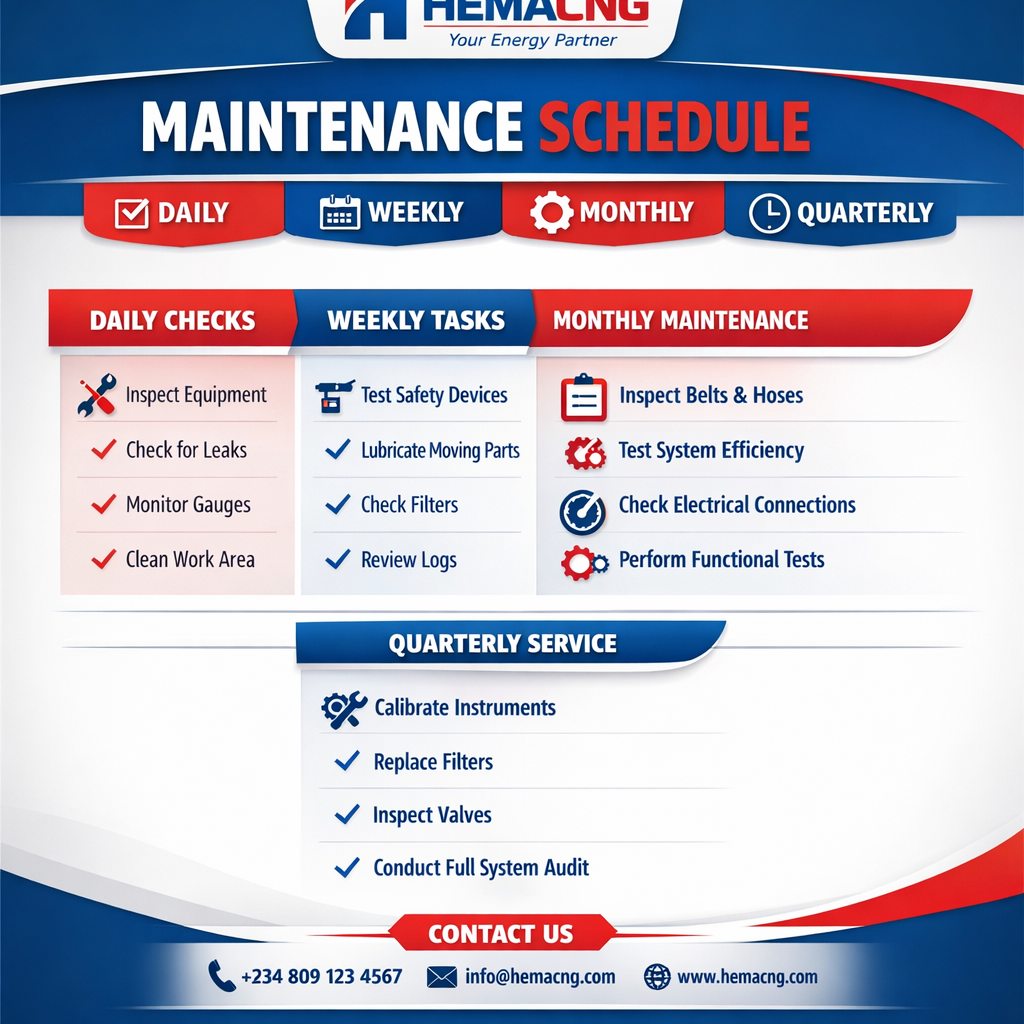
The Complete Equipment Care Schedule
Here’s a schedule you can print and post in every department:
| Frequency | What to Do | Who Does It |
|---|---|---|
| After Every Use | Clean surfaces, disinfect, return accessories | Clinical staff |
| Daily | Visual inspection, power check, battery, alarms | Assigned staff |
| Weekly | Deep cleaning, cable inspection, consumable check | Department lead |
| Monthly | Performance verification, safety checks | Biomedical team |
| Quarterly | Preventive maintenance, calibration, updates | Professional engineers (HemacNG) |
| Biannually | Full evaluation, electrical safety testing | Professional engineers (HemacNG) |
| Annually | Deep cleaning, cable inspection, and consumable check | Administration + HemacNG |
For professional maintenance, schedule a service with HemacNG. We serve hospitals in Nigeria and any country worldwide.
12 Equipment Care Mistakes Costing Your Hospital Millions
Let me save you some expensive and potentially dangerous lessons:
| Mistake | Better Approach |
|---|---|
| Skipping daily cleaning | Clean after EVERY patient contact |
| Ignoring warning signs | Report immediately, every time |
| Using household cleaners | Manufacturer-recommended solutions only |
| Operating without training | Mandatory training before first use |
| Postponing preventive maintenance | Invest in scheduled PM programs |
| Using counterfeit spare parts | Genuine OEM parts exclusively |
| Storing equipment improperly | Follow storage guidelines strictly |
| Zero maintenance documentation | Document EVERYTHING |
| Staff attempting DIY repairs | Only qualified engineers repair equipment |
| Keeping equipment past useful life | Plan replacements proactively |
| Permanently silencing alarms | Address alarm causes properly |
| No equipment care policy | Develop written protocols per department |
Even fixing three or four of these mistakes would save your hospital significant money and dramatically improve equipment reliability. For more on smart equipment purchasing that prevents many care issues, read: Better Ways for Hospitals to Buy Medical Equipment.
Building an Equipment Care Culture
Knowing how to take care of hospital equipment is important. But building a culture of care is transformative. A culture of care means:
Leadership commitment — Administrators visibly prioritizing and fund equipment care. Not just talking about it — demonstrating it.
Written policies — Clear equipment care protocols for every department. Posted. Referenced. Followed.
Clear responsibilities — Every staff member knows exactly what they’re accountable for.
Adequate resources — Cleaning supplies, storage solutions, checklists, and tools readily available.
Continuous training — Not just initial orientation, but ongoing education and skill reinforcement.
Easy reporting systems — Simple ways to report problems, with consistent follow-through.
Recognition — Celebrating departments and individuals who demonstrate excellent equipment care.
Regular audits — Checking compliance, identifying gaps, and measuring improvement.
Expert partnerships — Working with professional service providers like HemacNG for the expertise your in-house team may not have.
Culture change takes time. Start with one department. Show results. Let success spread naturally. Before long, equipment care becomes “just how we do things here.”
How HemacNG Supports Your Equipment Care Journey
Throughout this guide, you’ve seen HemacNG mentioned repeatedly. Here’s why: understanding equipment care is only half the solution. Having the right partner is the other half.
Quality Equipment Built to Last: We supply medical equipment from reputable global manufacturers. Durable, reliable, and designed for easy maintenance. Every product meets CE, FDA, and ISO standards. Browse our catalogue.
Professional Maintenance Programs: Customized preventive maintenance. Corrective repairs. Calibration services. Performance testing. All by certified engineers. Explore our services.
Genuine Spare Parts: OEM-approved parts for all major brands. Verified authenticity. Reliable supply chain. Order parts.
Staff Training: Operation training. Care protocols. Safety procedures. Refresher courses. We empower your team. Learn more.
Worldwide Delivery: Equipment and support are delivered to hospitals in any country worldwide. Lagos or London. Abuja or Amsterdam. Nairobi or New York. We’re there. Contact us.
Long-Term Partnership: We don’t disappear after delivery. We grow alongside your hospital. About HemacNG.

Your Free Printable Equipment Care Checklists
Here are checklists your team can start using immediately. Daily Checklist (Per Shift):
- Visual inspection completed: no damage
- Equipment powers on normally
- Battery status: adequate
- Alarms tested and functioning
- Equipment cleaned and disinfected
- Accessories present and functional
- No error messages
- Issues reported (if any)
- Signed: _________ Date: _______
Weekly Checklist:
- Deep cleaning completed
- Cables and connectors inspected
- Consumables restocked
- Function testing performed
- Storage areas organized
- Battery charging verified
- Outstanding issues followed up on
- Signed: _________ Date: _______
Monthly Checklist:
- Performance verification completed
- Safety checks performed
- Consumables replaced
- Documentation updated
- Professional maintenance scheduled
- Inventory updated
- Staff compliance reviewed
- Signed: _________ Date: _______
Frequently Asked Questions
How should nurses take care of medical equipment?
Nurses should clean equipment after every patient use, perform daily inspections, handle devices carefully, follow operating procedures, report problems immediately, and store equipment properly. Regular training ensures confidence and competence.
How often should hospital equipment be serviced?
Life-support devices need monthly to quarterly professional maintenance. Most clinical equipment requires quarterly-to-biennial servicing. Daily user care should happen every shift.
Who is responsible for equipment care?
Everyone in the hospital shares responsibility. Clinical staff handle daily care and reporting. Biomedical engineers manage professional maintenance. Administrators ensure policies and budgets. Partners like HemacNG provide specialized support.
How can hospitals extend equipment lifespan?
Clean daily, handle carefully, implement preventive maintenance, use genuine spare parts, train staff properly, store correctly, document everything, and partner with reliable service providers.
What happens when equipment isn’t maintained?
Consequences include inaccurate readings, misdiagnoses, equipment failures, infections, regulatory non-compliance, higher costs, shortened lifespan, and potential legal liability.
Does HemacNG provide maintenance services worldwide?
Yes. HemacNG provides comprehensive maintenance, calibration, spare parts, and training for hospitals in Nigeria and any country worldwide.
Care for Your Equipment, Care for Your Patients
Let me bring this full circle. Remember that incubator from the beginning of this guide? That tiny machine is keeping a tiny baby alive? Every piece of equipment in your hospital carries that same weight. They’re not just machines
When you clean that monitor, you’re protecting a heartbeat. When you inspect that ventilator, you’re guarding a breath.
How to take care of hospital equipment isn’t just a maintenance topic. It’s a patient safety commitment. It’s a financial strategy. And it’s one of the most meaningful things you can do in healthcare.
Start with the basics. Clean after use. Inspect daily. Handle with care. Report immediately. Store properly. Then build up. Schedule maintenance. Calibrate regularly. Use genuine parts. Train your team. Document everything. And remember, you never have to do it alone. HemacNG is here. With quality equipment built to last. Professional maintenance that keeps it running. Genuine spare parts when you need them. Training that empowers your staff. And delivery to your doorstep, wherever in the world you are. Ready to give your equipment the care it deserves? Contact HemacNG today. Let’s keep your equipment running and your patients safe, together.